Research / Partial differential equations
Dynamics of Partial Differential Equations
A main part of my research focuses on developing a functional analytic approach to study the dynamics of PDEs. Combining numerical analysis, topological methods, nonlinear analysis, scientific computing, continuation methods, functional analysis and fixed point theory, one of my goals is to develop a general computational theory to obtain computer-assisted proofs of existence of dynamical objects arising in infinite dimensional dynamical systems: steady states, periodic orbits, traveling waves, invariant manifolds, connecting orbits, bifurcations, etc.
Rigorous integration of parabolic PDEs
Following solutions of evolution equations in time with guaranteed accuracy is a central task of computer-assisted proofs. In [57] and [77], we solve initial value problems for semilinear parabolic PDEs using space-time expansions in Fourier and Chebyshev series, and in [71] we combine Chebyshev series with semigroup theory to treat higher-dimensional domains. These integrators give proofs of existence over long time intervals and, combined with trapping regions, global existence results: for instance, solutions of the Swift–Hohenberg equation converging to nontrivial equilibria, and a global solution of the 2D Navier–Stokes equations for a nontrivial initial condition.
Gap solitons in Bose–Einstein condensates
Gap solitons are localized solutions that play a central role in the physics of Bose–Einstein condensates. In [76], we turn numerical simulations of gap solitons in the one-dimensional Gross–Pitaevskii equation into rigorous proofs of existence. The key idea is to view each soliton as a homoclinic orbit of an associated dynamical system, and to derive verifiable conditions under which a numerically computed trajectory lies close to a true homoclinic orbit. This provides the first computer-assisted proofs of gap solitons in the Gross–Pitaevskii equation in non-perturbative parameter regimes.
Localized traveling waves in two dimensions
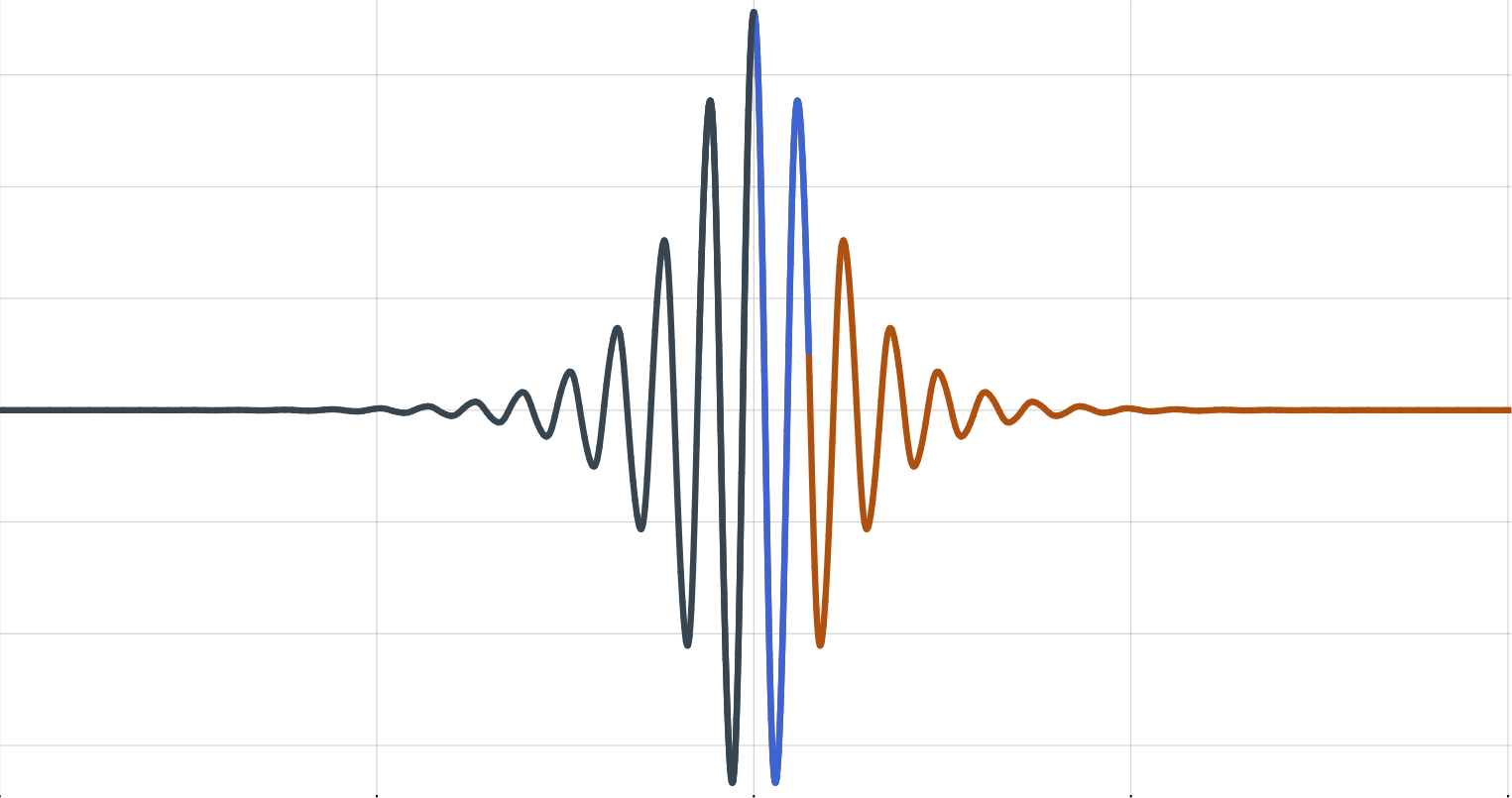
Traveling waves are an essential feature of suspension bridge models, but in two space dimensions they had only been observed in numerical simulations. In [75], we prove the existence of periodic localized traveling waves in the two-dimensional suspension bridge equation. The main difficulty comes from the exponential nonlinearity combined with the large amplitude of the waves, which we overcome by rigorously controlling the aliasing error in the computed Fourier coefficients. The approach extends to other wave equations and to elliptic PDEs with analytic nonlinearities, in two and higher dimensions.
PDEs on the disk via Zernike polynomials
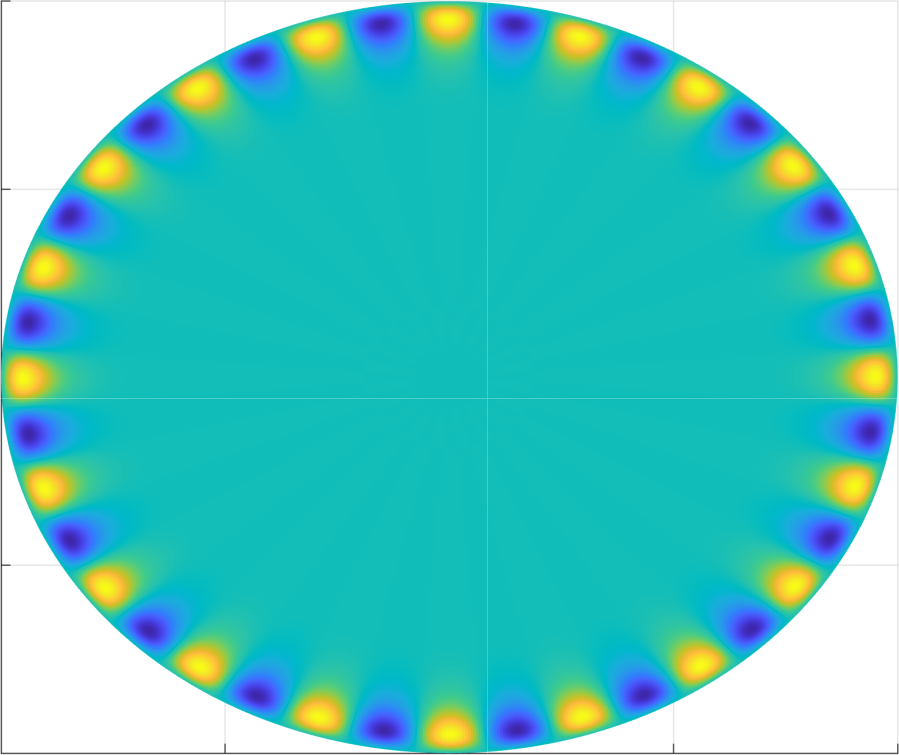
Many physical problems are posed on geometries such as disks and cylinders, where standard Fourier methods no longer apply. In [74], we introduce a validated Matrix Multiplication Transform, a rigorous analogue of the discrete Fourier transform that allows nonlinear terms to be evaluated reliably in spectral methods. Combined with Zernike polynomials, a natural spectral basis on the disk, it gives an accurate and efficient way to multiply truncated series. We use this framework to prove the existence of solutions of two nonlinear elliptic PDEs on the disk.
Localized patterns on unbounded domains
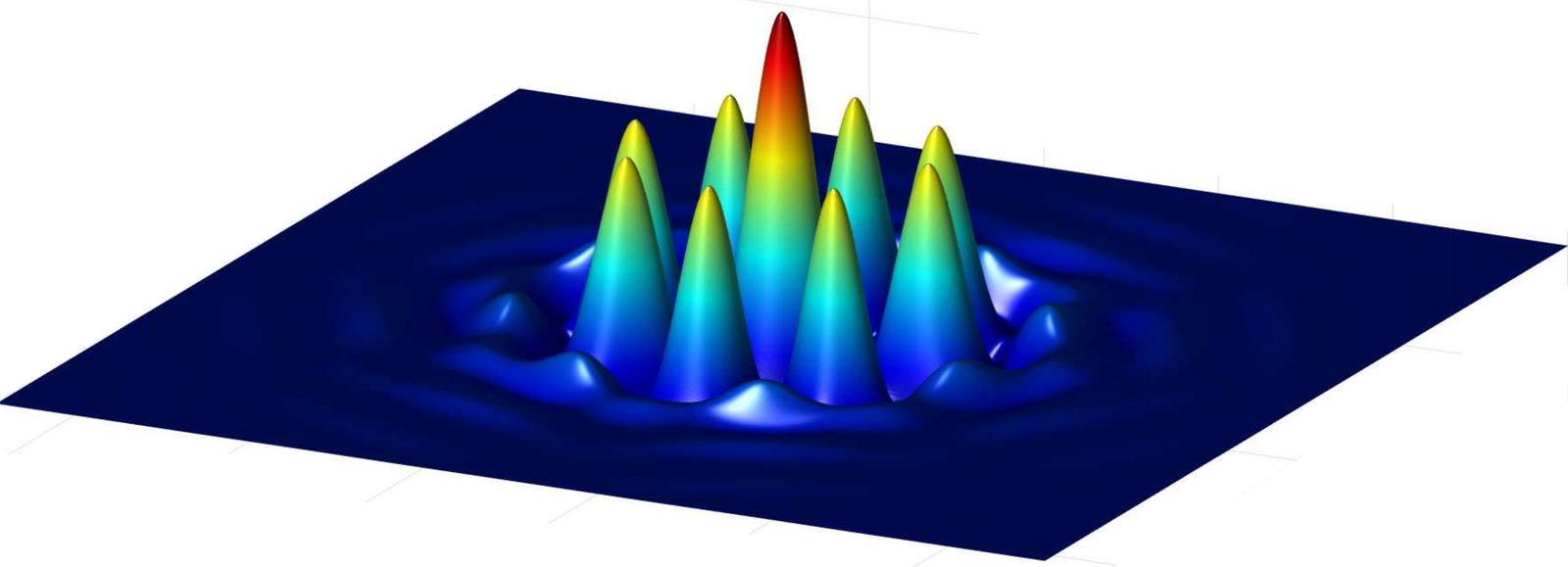
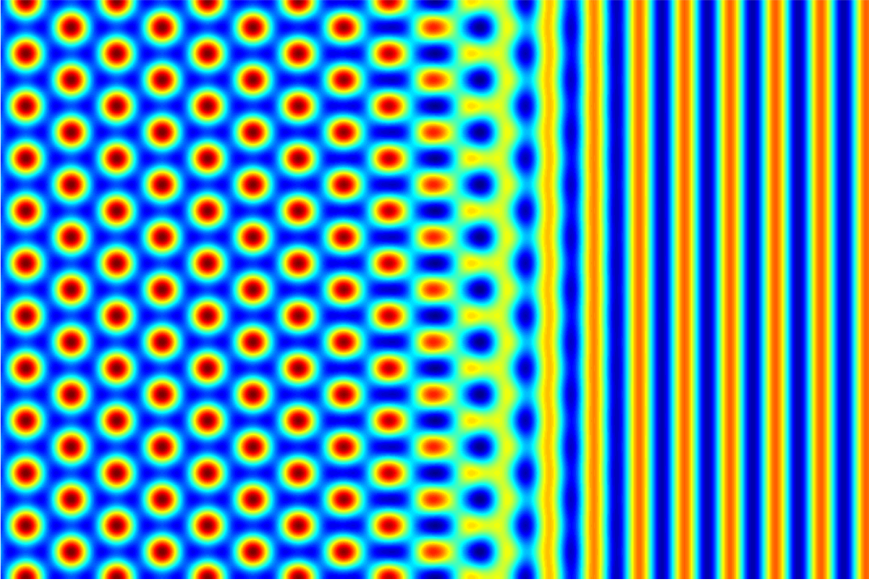
Localized patterns on the whole space are challenging for computer-assisted proofs, since the problem is posed on an unbounded domain. In [69], we develop a fully spectral method, based on Fourier series, to prove the existence of solutions of semilinear PDEs on ℝm, and use it to prove the existence and stability of a soliton in the Kawahara equation. In [70], we prove the existence of stationary non-radial localized patterns in the planar Swift–Hohenberg equation, and show that each of them is the limit of an unbounded branch of spatially periodic solutions as the period tends to infinity.
Localized radial solutions of elliptic systems
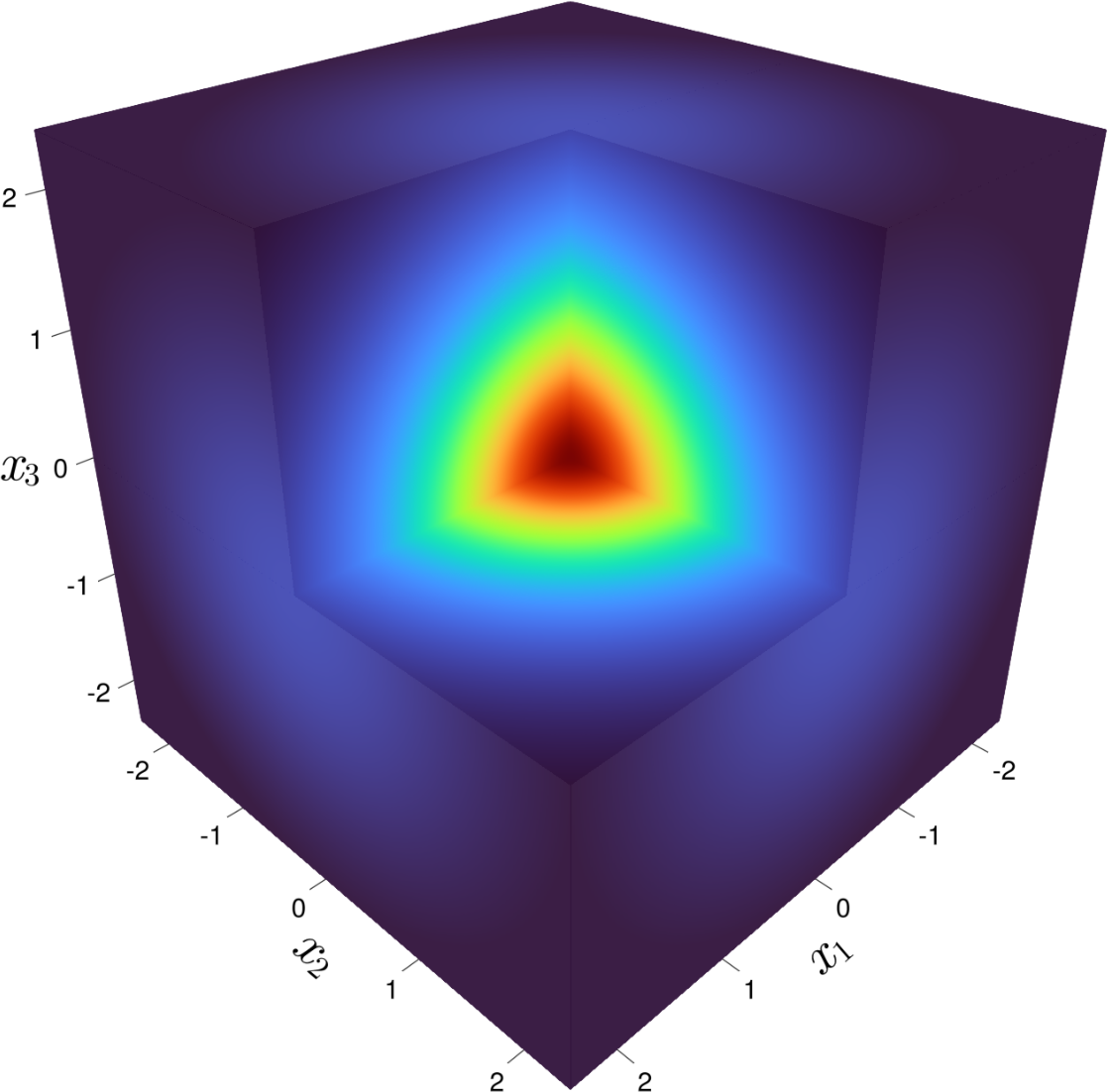
Ground states of elliptic equations are fundamental spatial patterns, yet little is known about them for general systems of nonlinear elliptic equations. In [66], we present a general method to prove the existence of localized radially symmetric solutions of elliptic systems on ℝd, which reduce to non-autonomous ordinary differential equations in the radial variable. Combining dynamical systems theory with computer-assisted proofs, we establish localized radial solutions of the cubic Klein–Gordon equation in three dimensions, the Swift–Hohenberg equation in the plane and a three-component FitzHugh–Nagumo system.
Singularities and complex-time dynamics
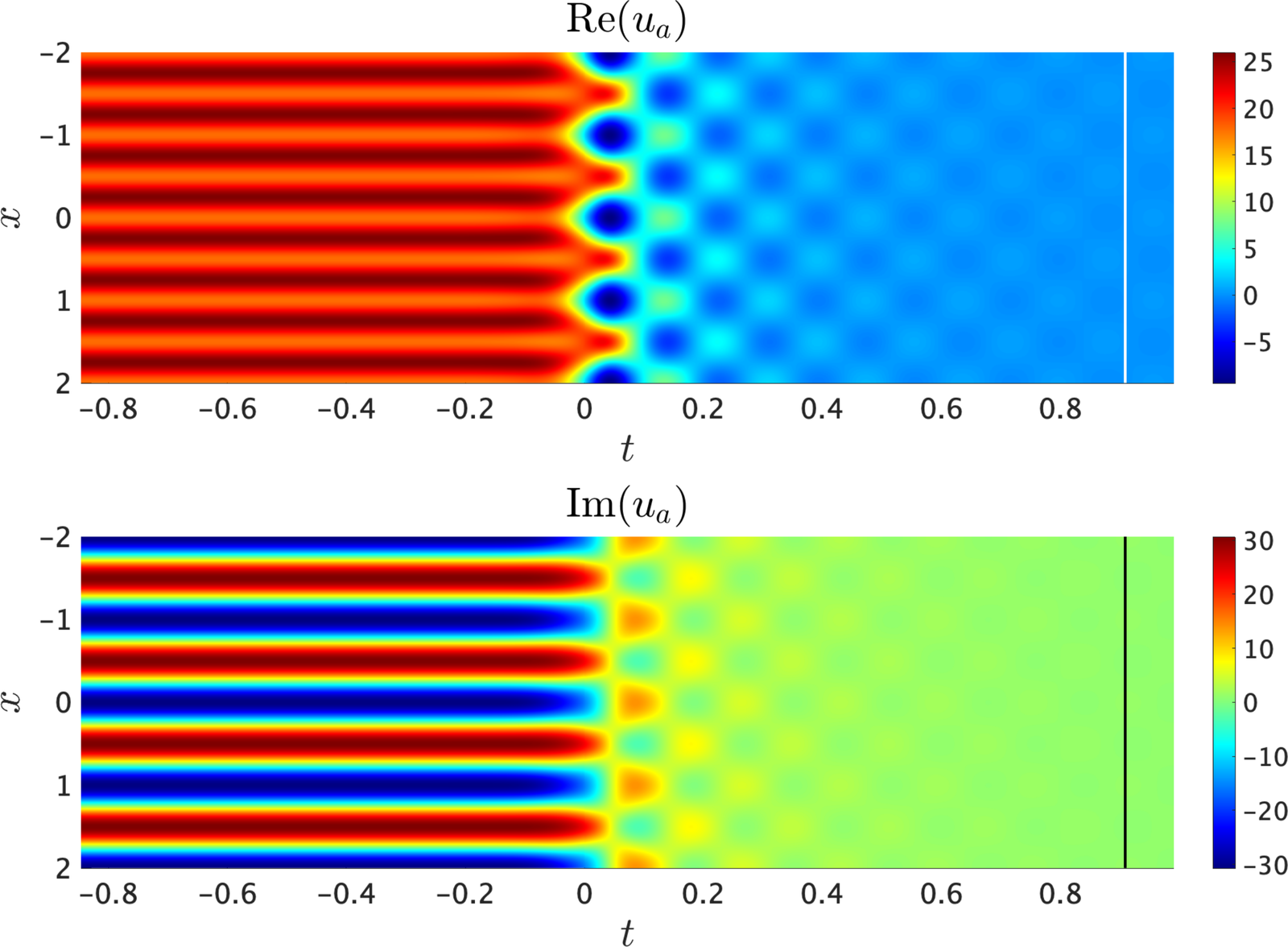
Extending time to the complex plane reveals hidden singularities of evolution equations. In [61], we compute rigorous inclusions of solutions of nonlinear heat equations for complex time values, prove the existence of a branching singularity and establish global existence for an open set of solutions. In [59], we show that, for a class of nonlinear Schrödinger equations, an open set of solutions converges to zero in both time directions, which rules out any real-analytic conserved quantity. In [56] and [59], we prove heteroclinic orbits connecting nontrivial equilibria to zero, which in turn force the existence of unbounded solutions.
Rotation invariant and radially symmetric patterns
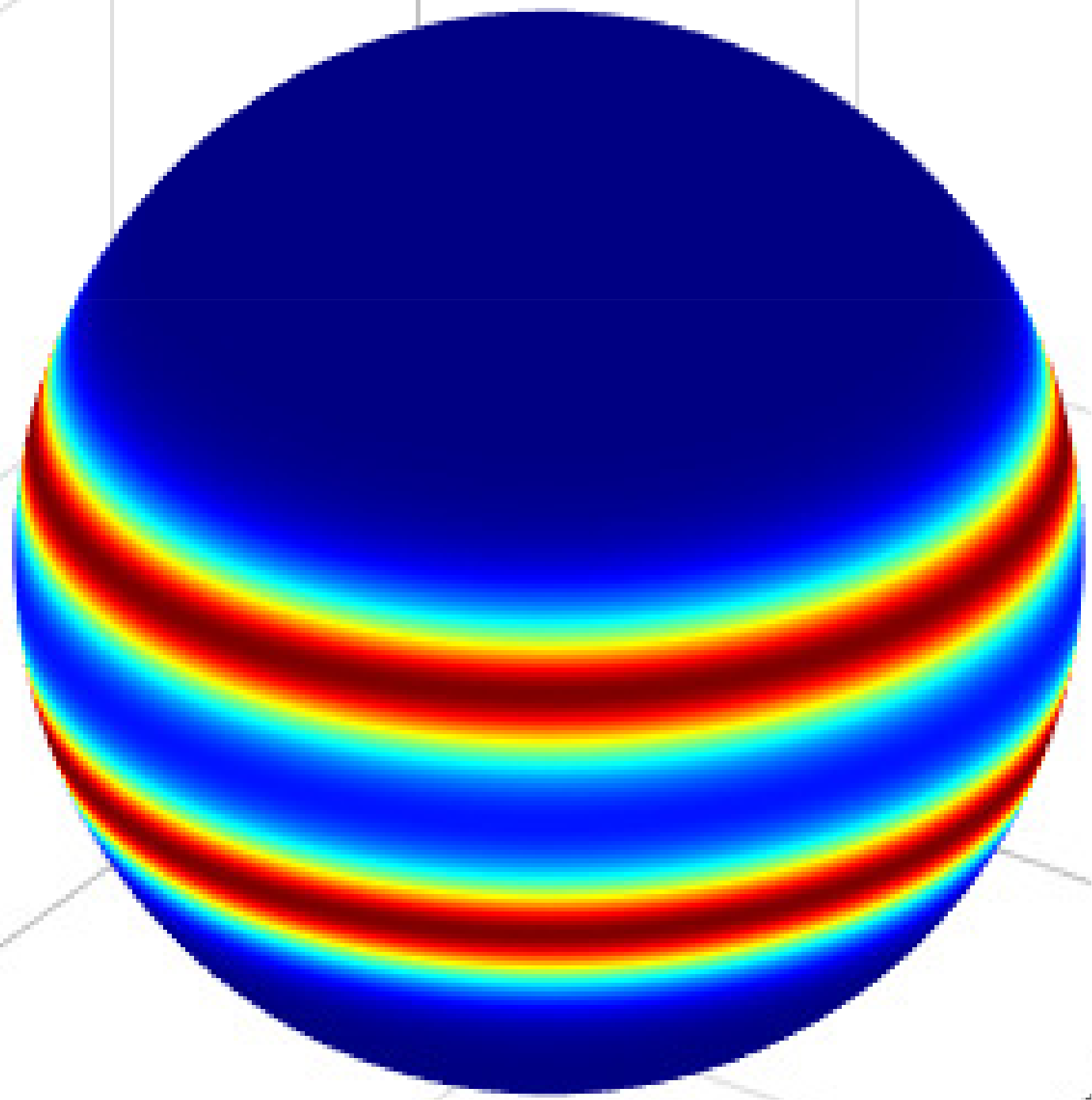
In [42], we introduce, through examples accessible to undergraduate students, a computer-assisted approach based on Taylor series to prove the existence of radially symmetric solutions of PDEs. In [60], we extend these ideas to prove the existence of rotation invariant patterns of a nonlinear Laplace–Beltrami equation on the sphere. The singularity at the pole is handled with a Taylor series expansion nearby, combined with a Chebyshev series expansion away from it, and the whole problem is solved at once with a Newton–Kantorovich argument.
Patterns in the phase-field-crystal model
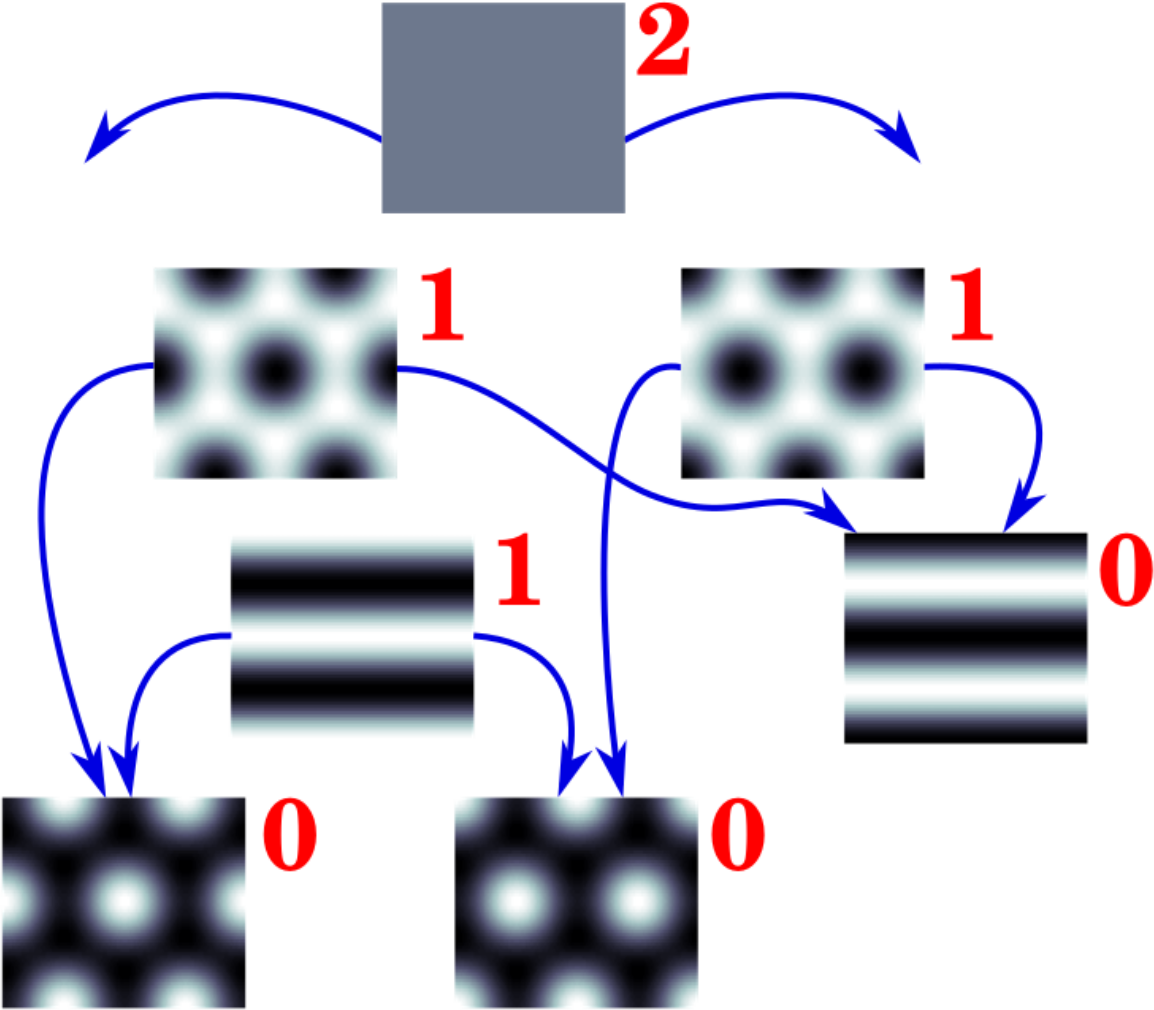
The phase-field-crystal model describes the formation of crystalline structures at the atomic scale. In [58], we use rigorously validated numerics to study the model at this microscopic level. We prove the existence of critical points and local minimizers of the associated energy that correspond to classical candidate patterns, grain boundaries and localized patterns. We then explore how these patterns are related dynamically, both for fixed parameters and across parameter space, and formulate several conjectures about the connecting orbits between steady states.
The Navier–Stokes equations
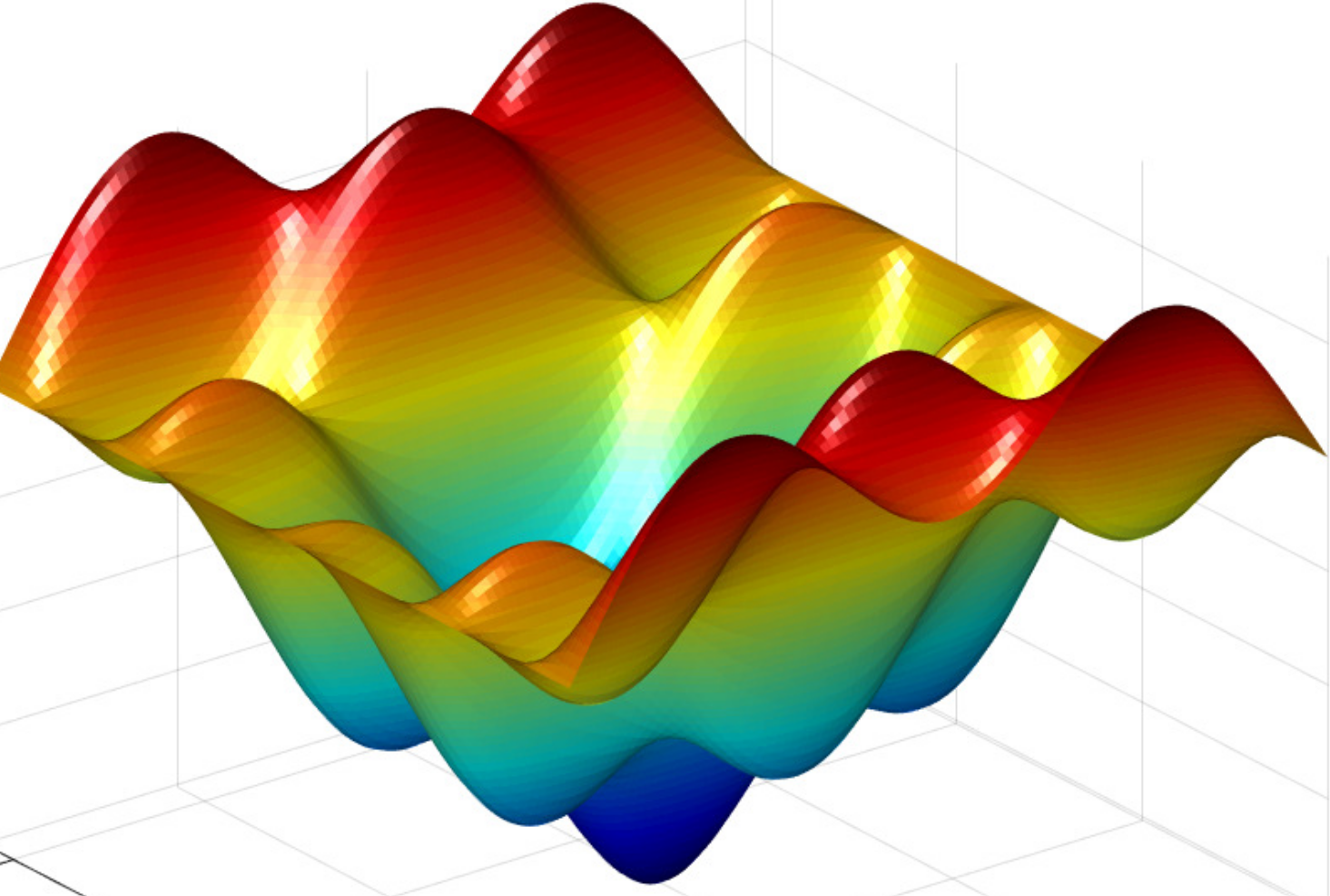
The Navier–Stokes equations describe the motion of fluids, and proving the existence of their time-periodic solutions is a notoriously hard problem. In [50], we develop a general method to obtain constructive proofs of periodic orbits in the forced Navier–Stokes equations on the torus. The problem is recast as a zero-finding problem on a space of geometrically decaying Fourier coefficients, and the symmetries of the model are used to reduce its size. As an application, we prove the existence of spontaneous periodic orbits, which arise although the Taylor–Green forcing does not depend on time.
Free vibrations of a MEMS membrane
Micro-electro-mechanical systems (MEMS) are tiny devices in which an elastic membrane deflects under an electrostatic force. In [46], we study a nonlinear wave equation modeling such a membrane, which has a unique branch of stable steady states up to a critical value of the voltage. We prove that infinitely many branches of periodic solutions, or free vibrations, bifurcate from this branch as the voltage varies. We also compute these branches numerically, and use the same functional setting to validate rigorously the steady state at the critical value.
A Kuramoto–Sivashinsky equation with absorption
Traveling wave patterns of a signed Kuramoto–Sivashinsky equation with absorption are described by a fourth-order piecewise linear ordinary differential equation. Galaktionov and Svirshchevskii conjectured that this equation has a unique, asymptotically stable periodic orbit. In [44], we give a partial proof of this conjecture. A computer-assisted proof first establishes the existence of the periodic orbit, and the rigorous bounds obtained in phase space are then combined with the theory of discontinuous dynamical systems to prove that the orbit is asymptotically stable.
The ill-posed Boussinesq equation
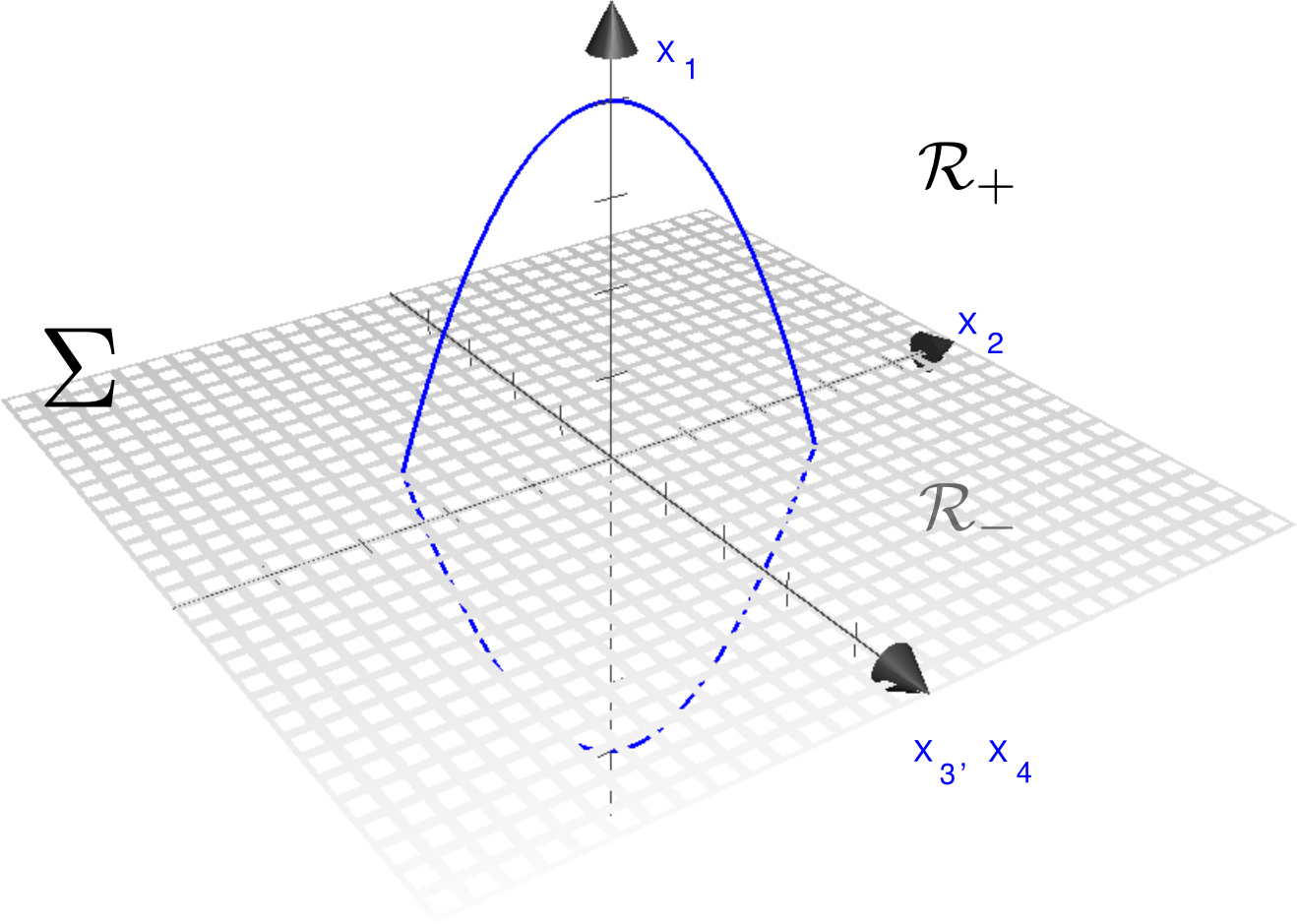
Ill-posed equations do not generate a dynamical system and have received little attention in computer-assisted proofs. In [37], we develop computer-assisted techniques to study periodic orbits of ill-posed PDEs. As a case study, we consider the Boussinesq equation, which plays an important role in the theory of shallow water waves. Using the symmetries of the solutions to isolate them, we prove the existence of several periodic orbits at different parameter values, in a space of space-time Fourier coefficients with geometric decay.

Traveling waves in the suspension bridge equation
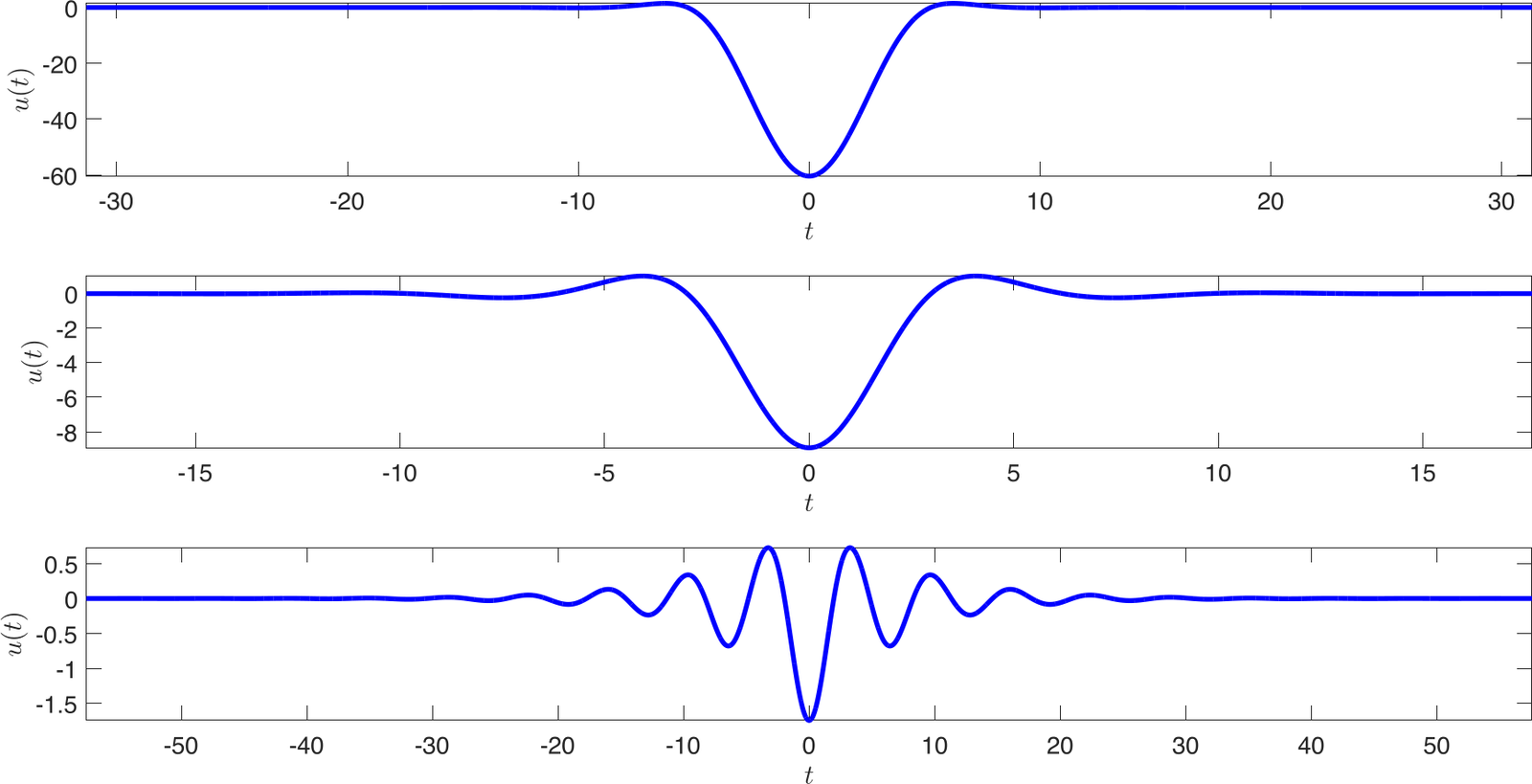
The suspension bridge equation describes the deflection of the roadway of a bridge, and its traveling waves correspond to disturbances propagating along the deck. In [36], we prove the existence of symmetric homoclinic orbits of the equation u′′′′ + βu′′ + eu − 1 = 0 for all parameter values β ∈ [0.5, 1.9]. This gives a large continuous family of solitary traveling waves and partially solves a conjecture of Chen and McKenna [Philos. Trans. Roy. Soc. London Ser. A 355 (1997)]. The proof combines a parameterization of the stable manifold with a rigorous continuation argument.
The Kuramoto–Sivashinsky equation
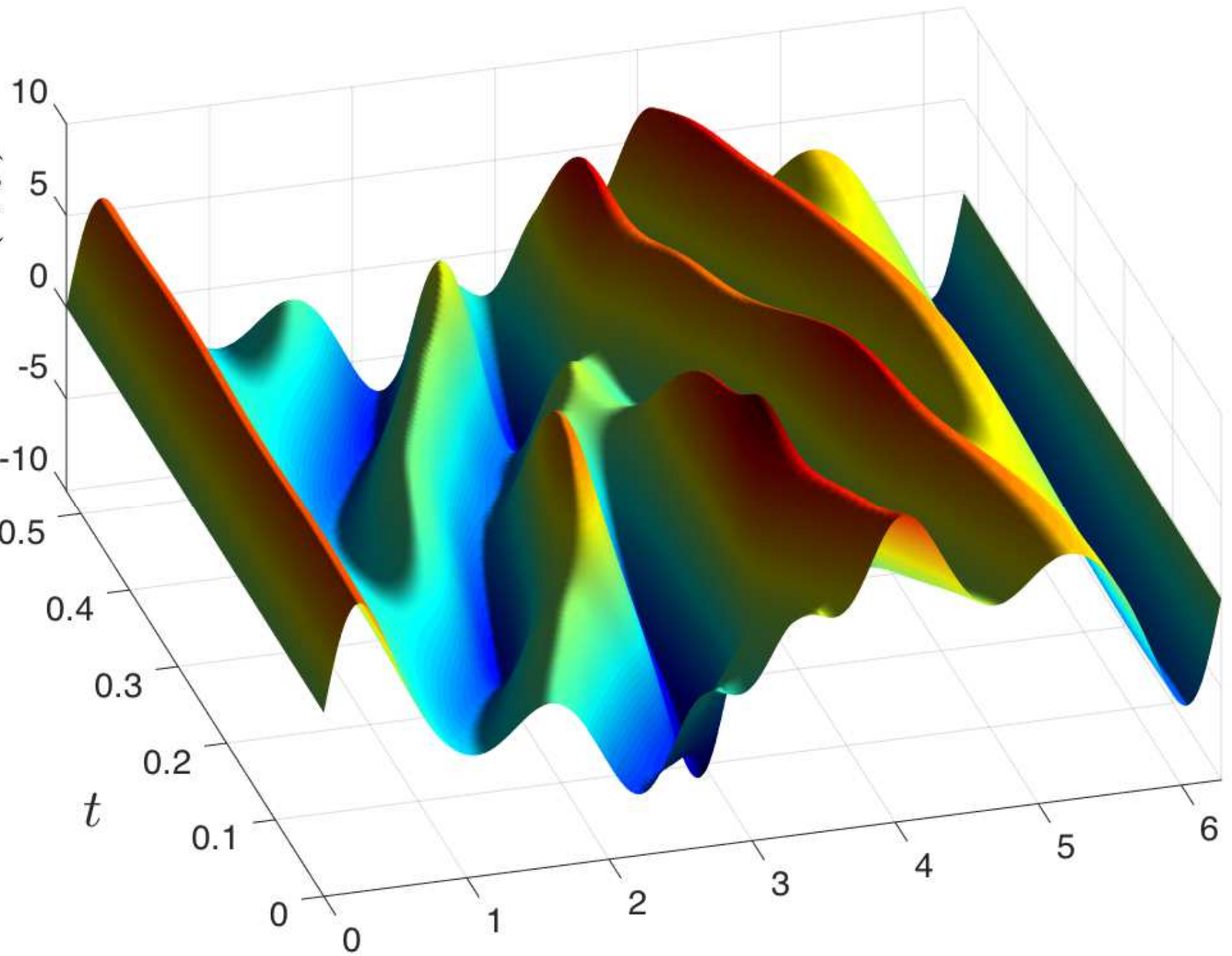
The Kuramoto–Sivashinsky equation is a popular model of weak turbulence and spatiotemporal chaos. In [32], we develop a general framework for computer-assisted proofs of invariant objects of semilinear PDEs, such as equilibria, traveling waves, periodic orbits and their invariant manifolds. In [31], we apply it to the Kuramoto–Sivashinsky equation: we compute a global continuous branch of periodic orbits, rigorously enclose their Floquet exponents, and prove that some of these periodic orbits are unstable.
Breakdown of analyticity
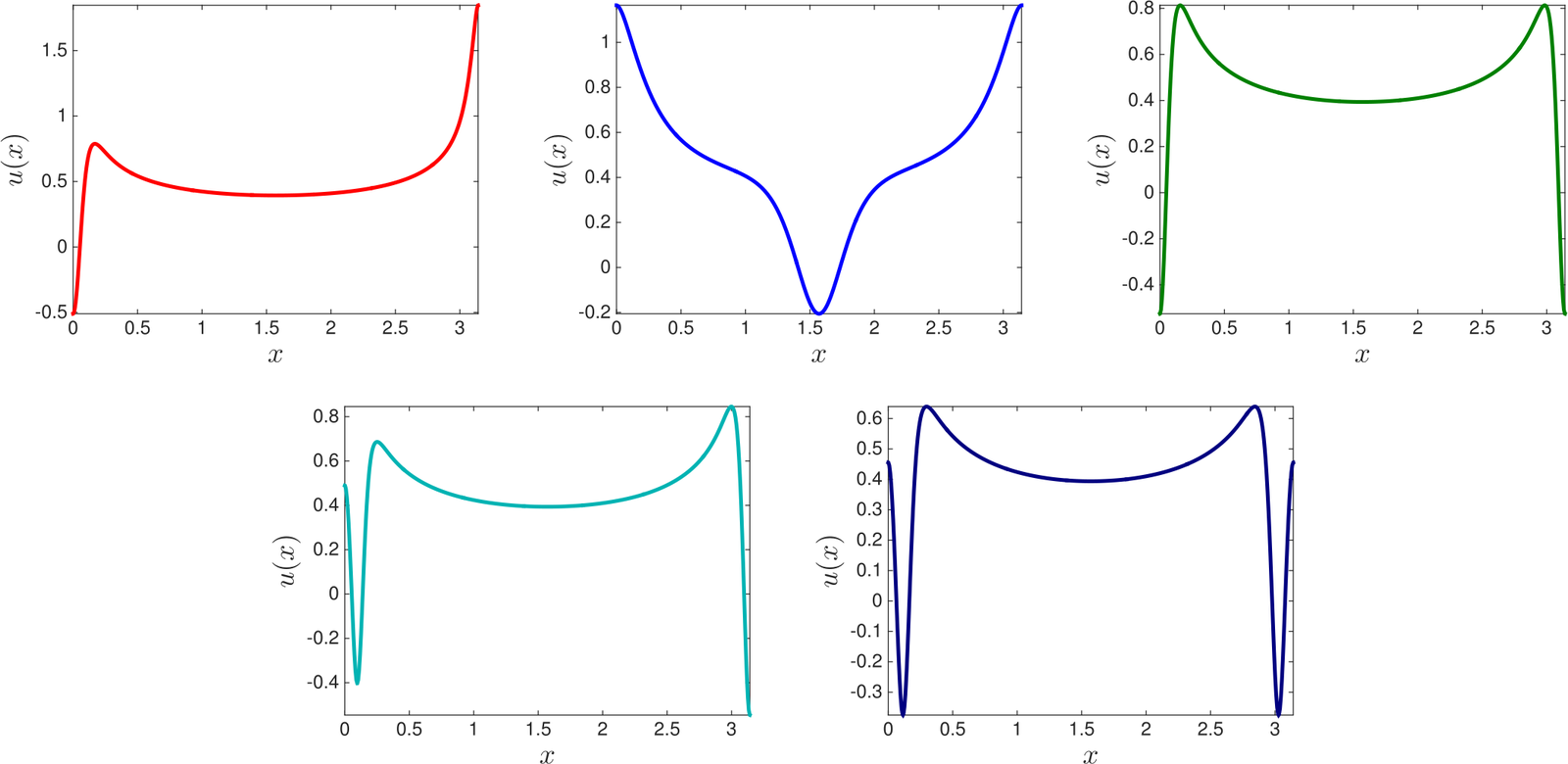
The regularity of a solution strongly affects how well it can be approximated numerically. In [30], we develop a functional analytic framework for computer-assisted Fourier analysis in sequence spaces of varying regularity, from finitely differentiable to analytic, which yields existence and regularity results at the same time. We use it to study steady states of a spatially inhomogeneous Fisher equation near the breakdown of analyticity, and show that spaces of algebraically decaying coefficients are well suited to this regime.
Coexistence of hexagons and rolls
Hexagons and rolls are the two most common patterns in two-dimensional pattern formation, and they can coexist in space. In [21], we prove the existence of standing fronts connecting a region of rolls to a region of hexagons in a pattern formation model, settling a conjecture of Doelman et al. [European J. Appl. Math. 14 (2003)]. These fronts are heteroclinic solutions of a system of two second-order differential equations, which we obtain by solving a boundary value problem with boundary conditions in the stable and unstable manifolds.
Steady states on higher-dimensional domains
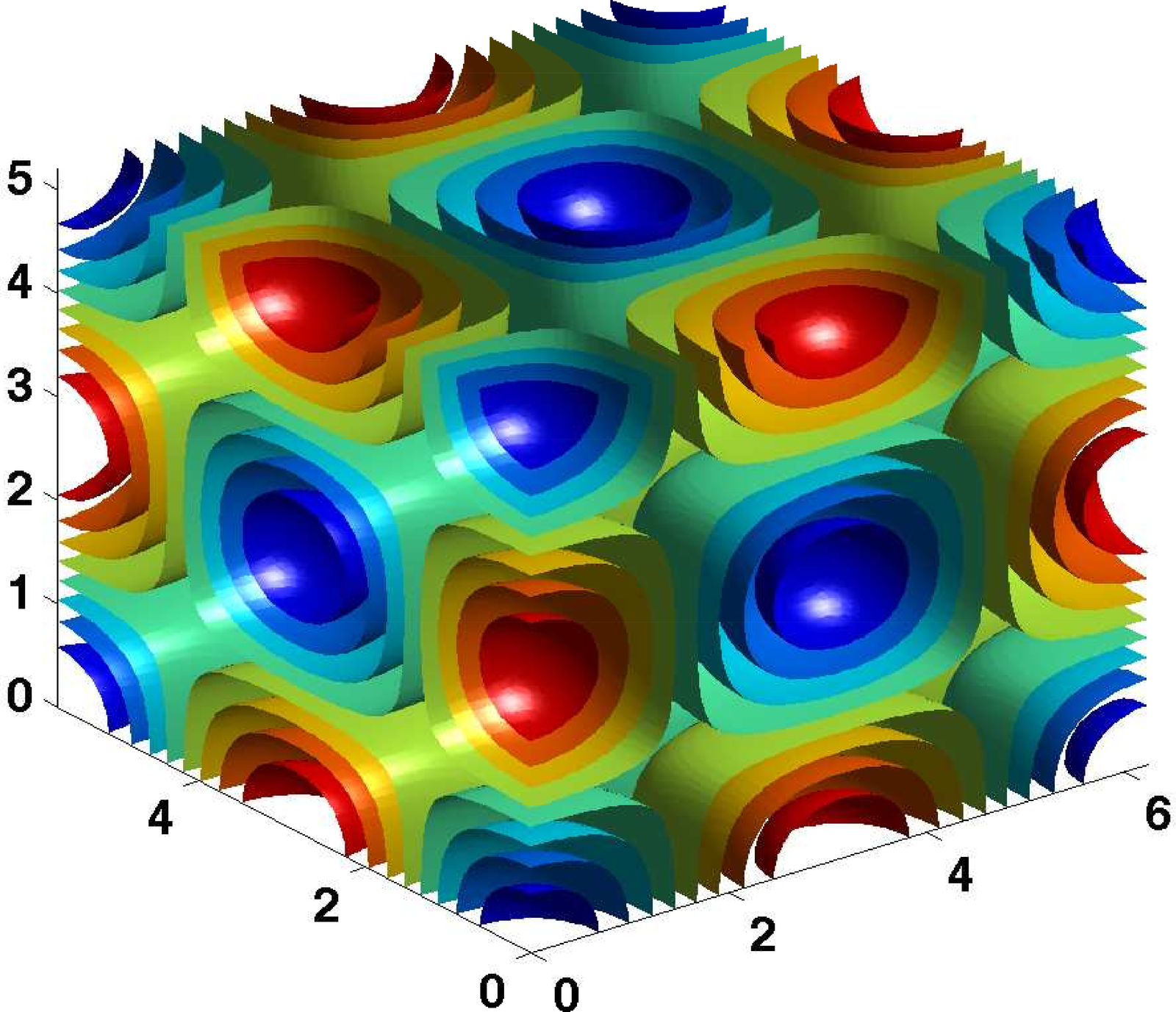
Identifying the equilibria is the first step to understanding the dynamics of a parabolic PDE. In [1, 2], we introduce validated continuation, which verifies that each equilibrium computed numerically along a branch corresponds to a true, locally unique equilibrium of the PDE, at less than twice the cost of standard continuation. In [6, 7], we extend the method to two- and three-dimensional domains and prove the existence of global smooth branches of equilibria of the Cahn–Hilliard equation. In [11], we show that one-dimensional estimates make such proofs much cheaper than refining the numerical computation.
Pulses in the Gray–Scott model
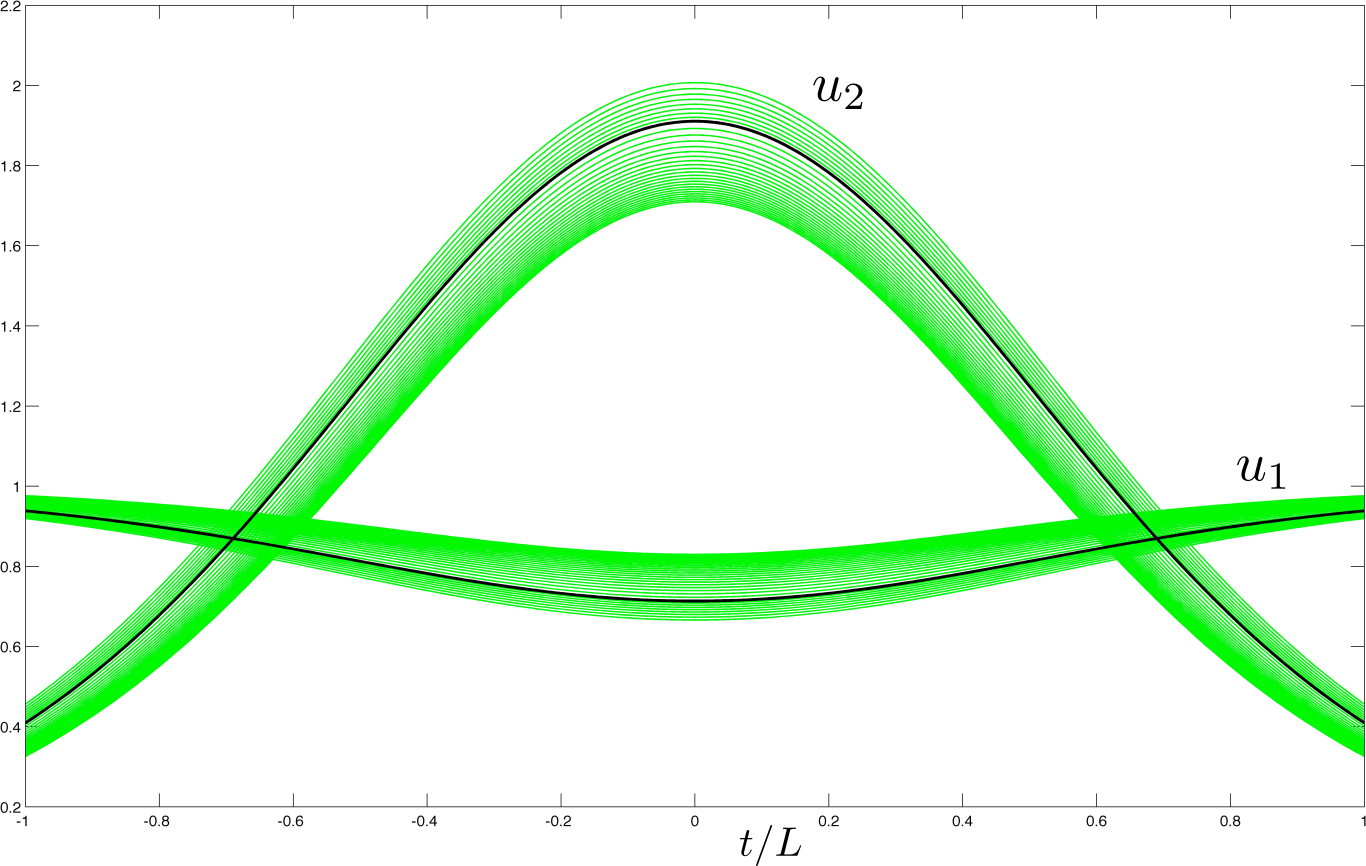
The Gray–Scott model describes an autocatalytic chemical reaction and is known for its rich variety of pulses and patterns. In [9], we prove the existence of a family of even homoclinic orbits of the Gray–Scott system, which correspond to symmetric pulses. To do so, we introduce a rigorous numerical technique for symmetric connecting orbits of ordinary differential equations, which solves a projected boundary value problem using high-order parameterizations of the invariant manifolds and explicit bounds on their coefficients.
Related publications
- [77]Recent advances about the rigorous integration of parabolic PDEs via fully spectral Fourier-Chebyshev expansionsM. Cadiot and J.-P. LessardNumerische Mathematik, 158(4): 1237–1289, 2026
- [76]Computer-Assisted Proofs of Solitons in Bose-Einstein CondensatesM. Ayala, C. García-Azpeitia and J.-P. LessardJournal of Nonlinear Science, 36(2), Paper No. 28, 2026
- [75]Periodic localized traveling waves in the two-dimensional suspension bridge equationL. van der Aalst, J.B. van den Berg and J.-P. LessardNonlinearity, 38(7), Paper No. 075029, 2025
- [74]Validated matrix multiplication transform for orthogonal polynomials with applications to computer-assisted proofs for PDEsCommunications in Nonlinear Science and Numerical Simulation, Volume 151, Paper No. 109063, 2025
- [71]A rigorous integrator and global existence for higher-dimensional semilinear parabolic PDEs via semigroup theoryG. Duchesne, J.-P. Lessard and A. TakayasuJournal of Scientific Computing, 102(3), Paper No. 62, 66 pages, 2025
- [70]Stationary non-radial localized patterns in the planar Swift-Hohenberg PDE: constructive proofs of existenceM. Cadiot, J.-P. Lessard and J.-C. NaveJournal of Differential Equations, Volume 414, 555–608, 2025
- [69]Rigorous computation of solutions of semi-linear PDEs on unbounded domains via spectral methodsM. Cadiot, J.-P. Lessard and J.-C. NaveSIAM Journal on Applied Dynamical Systems, 23(3): 1966–2017, 2024
- [66]Constructive proofs for localized radial solutions of semilinear elliptic systems on dJ.B. van den Berg, O. Hénot and J.-P. LessardNonlinearity, 36(12): 6476–6512, 2023
- [61]Rigorous numerics for nonlinear heat equations in the complex plane of timeNumerische Mathematik, 151(3), 693–750, 2022
- [60]Rotation invariant patterns for a nonlinear Laplace-Beltrami equation: a Taylor-Chebyshev series approachJ.B. van den Berg, G. Duchesne and J.-P. LessardJournal of Computational Dynamics, 9(2): 253–278, 2022
- [59]Global dynamics in nonconservative nonlinear Schrödinger equationsJ. Jaquette, J.-P. Lessard and A. TakayasuAdvances in Mathematics, Volume 398, Paper 108234, 2022
- [58]Microscopic patterns in the 2D phase-field-crystal modelG. Martine La Boissonière, R. Choksi and J.-P. LessardNonlinearity, 35(3), 1500–1520, 2022
- [57]Validated forward integration scheme for parabolic PDEs via Chebyshev seriesJ. Cyranka and J.-P. LessardCommunications in Nonlinear Science and Numerical Simulation, Volume 109, Paper No. 106304, 2022
- [56]Singularities and heteroclinic connections in complex-valued evolutionary equations with a quadratic nonlinearityJ. Jaquette, J.-P. Lessard and A. TakayasuCommunications in Nonlinear Science and Numerical Simulation, Volume 107, Paper No. 106188, 2022
- [50]Spontaneous periodic orbits in the Navier-Stokes flowJournal of Nonlinear Science, 31(2): paper No. 41 (61 pages), 2021
- [46]Free vibrations in a wave equation modeling MEMSC. García-Azpeitia and J.-P. LessardSIAM Journal on Applied Dynamical Systems, 19 (4): 2749–2782, 2020
- [44]Traveling wave oscillatory patterns in a signed Kuramoto-Sivashinsky equation with absorptionY. Alama and J.-P. LessardJournal of Computational and Applied Mathematics, 372 (112608), 2020
- [42]Computer-assisted proofs for radially symmetric solutions of PDEsI. Balazs, J.B. van den Berg, J. Courtois, J. Dudas, J.-P. Lessard, A. Vörös- Kiss, JF Williams and X.Y. YinJournal of Computational Dynamics, 5(1-2): 61–80, 2018
- [37]Rigorous numerics for ill-posed PDEs: periodic orbits in the Boussinesq equationR. Castelli, M. Gameiro and J.-P. LessardArchive for Rational Mechanics and Analysis, 228(1):129–157, 2018
- [36]Continuation of homoclinic orbits in the suspension bridge equation: a computer-assisted proofJournal of Differential Equations, 264(5): 3086–3130, 2018
- [32]A framework for the numerical computation and a posteriori verification of invariant objects of evolution equationsSIAM Journal on Applied Dynamical Systems 16(2): 1070–1088, 2017
- [31]A posteriori verification of invariant objects of evolution equations: periodic orbits in the Kuramoto-Sivashinsky PDEM. Gameiro and J.-P. LessardSIAM Journal on Applied Dynamical Systems, 16(1): 687–728, 2017
- [30]Computer assisted Fourier analysis in sequence spaces of varying regularityJ.-P. Lessard and J.D. Mireles JamesSIAM Journal on Mathematical Analysis, 49(1), 530–561, 2017
- [21]Stationary coexistence of hexagons and rolls via rigorous computationsJ.B. van den Berg, A. Deschênes, J.-P. Lessard and J.D. Mireles JamesSIAM Journal on Applied Dynamical Systems, 14 (2), 942–979, 2015
- [11]Efficient rigorous numerics for higher-dimensional PDEs via one-dimensional estimatesM. Gameiro and J.-P. LessardSIAM Journal on Numerical Analysis, 51(4), 2063–2087, 2013
- [9]Rigorous numerics for symmetric connecting orbits: even homoclinics of the Gray-Scott equationSIAM Journal on Mathematical Analysis, 43 (4): 1557–1594, 2011
- [7]Rigorous computation of smooth branches of equilibria for the three-dimensional Cahn-Hilliard equationM. Gameiro and J.-P. LessardNumerische Mathematik, 117 (4): 753–778, 2011
- [6]Analytic estimates and rigorous continuation for equilibria of higher-dimensional PDEsM. Gameiro and J.-P. LessardJournal of Differential Equations, 249 (9): 2237–2268, 2010
- [2]Validated continuation over large parameter ranges for equilibria of PDEsM. Gameiro, J.-P. Lessard and K. MischaikowMathematics and Computers in Simulation, 79 (4), 1368–1382, 2008
- [1]Validated continuation for equilibria of PDEsS. Day, J.-P. Lessard and K. MischaikowSIAM Journal on Numerical Analysis, 45 (4), 1398–1424, 2007