Research / Delay differential equations
Dynamics of Delay Differential Equations
Another important aspect of my research consists of studying the dynamics of delay differential equations (DDEs), which naturally lead to infinite dimensional dynamical systems. I develop computer-assisted approaches to prove existence of periodic orbits, connecting orbits and chaotic dynamics in delay equations.
Invariant manifolds and homoclinic orbits
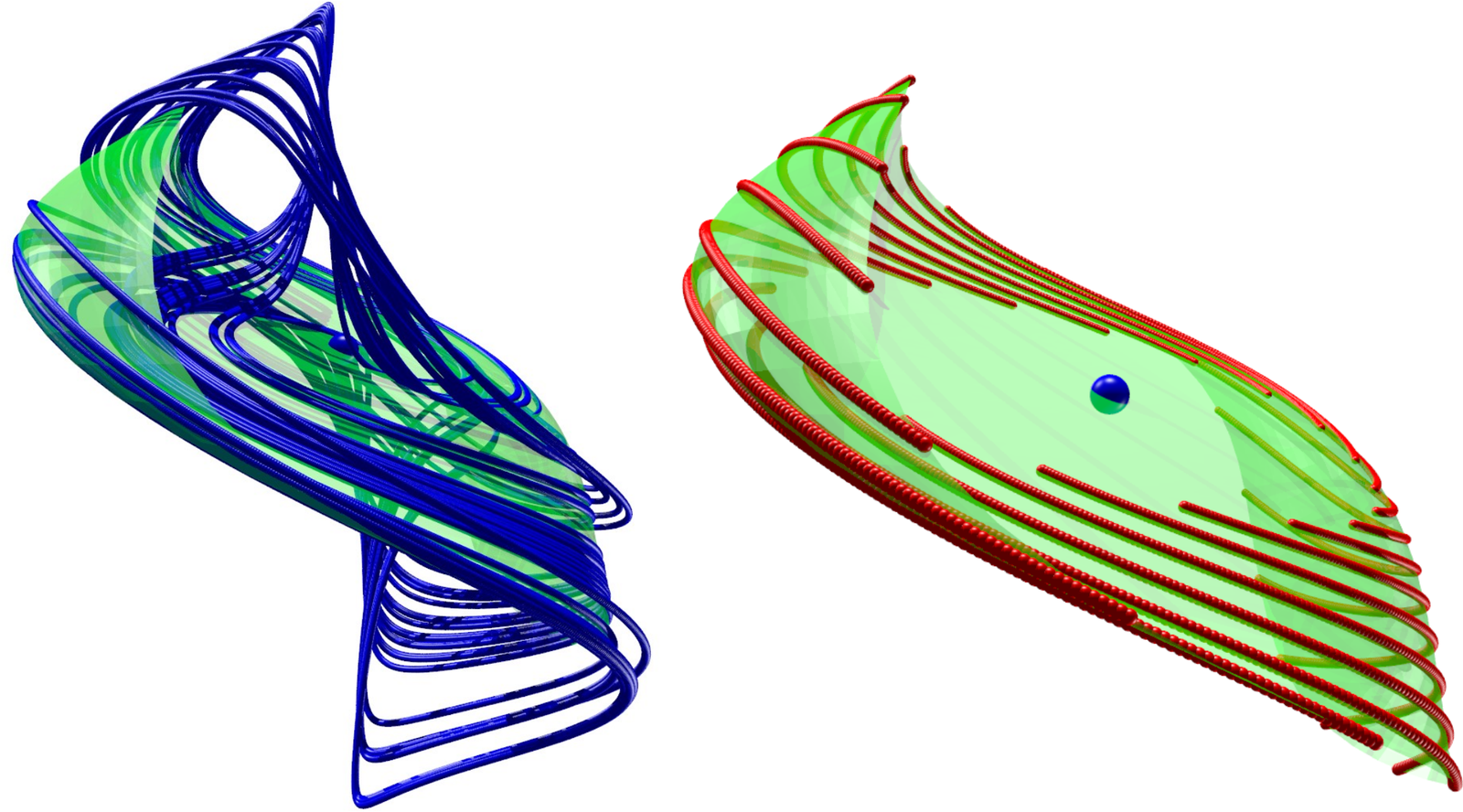
Invariant manifolds organize the global dynamics of delay equations. In [53], we compute high-order Taylor expansions of the unstable manifold of an equilibrium and prove rigorous error bounds for the truncated series. In [67], we compute transverse homoclinic orbits of periodic solutions, a classical mechanism behind chaotic dynamics known as the Poincaré scenario. The connecting orbit is obtained by solving a boundary value problem between the unstable and stable manifolds of the periodic orbit, and the method is illustrated on the cubic Ikeda and Mackey–Glass equations.
State-dependent delay perturbation of ODEs
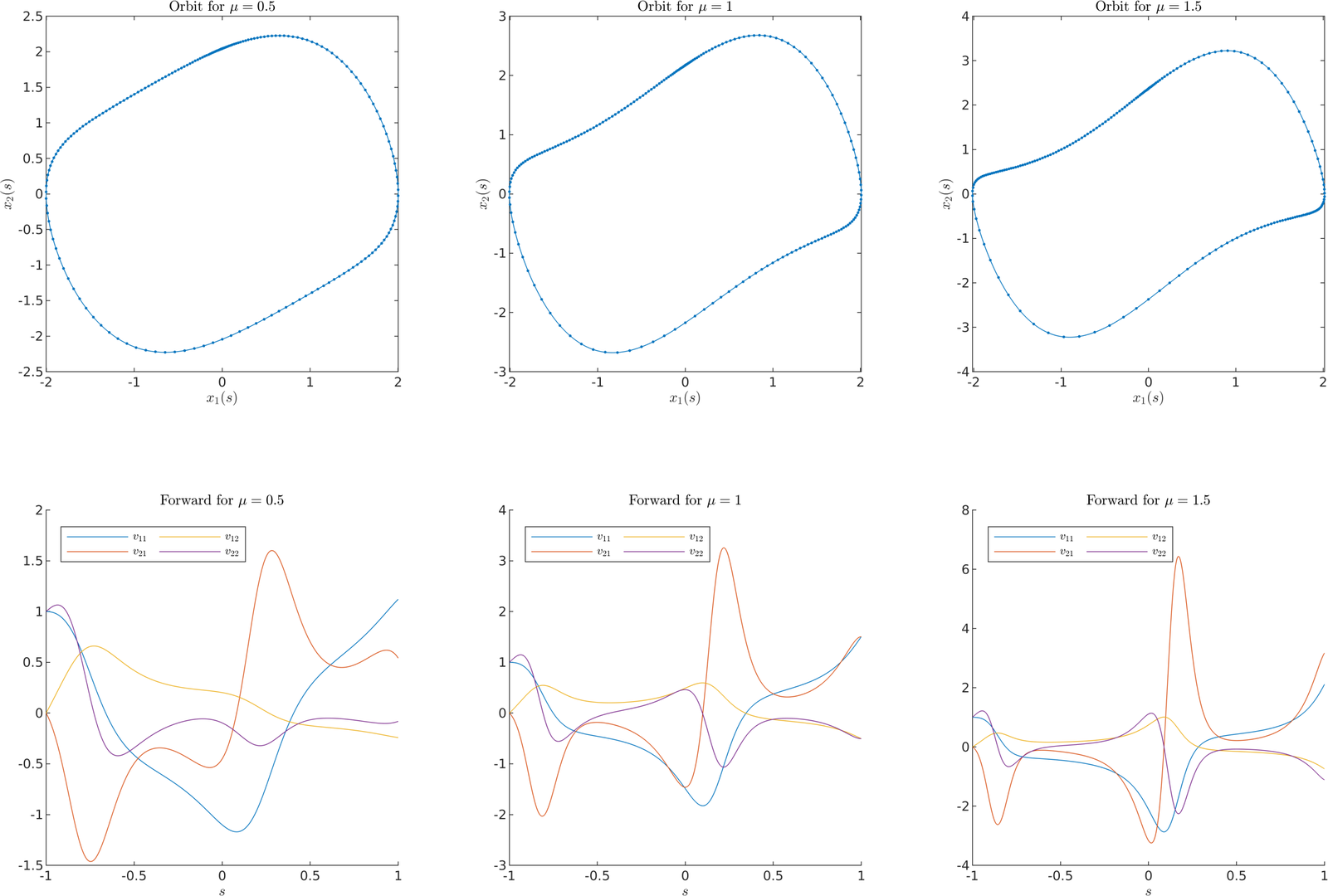
Delays that depend on the state of the system arise naturally in applications, but they make even basic questions about periodic orbits difficult. In [64], we start from an ordinary differential equation with an isolated periodic orbit and add a state-dependent delayed perturbation. We give a computer-assisted method, based on verifying a set of explicit polynomial inequalities, which proves that the periodic orbit persists in the perturbed delay equation. The method is applied to a state-dependent delayed perturbation of the van der Pol equation.
A general method for periodic solutions
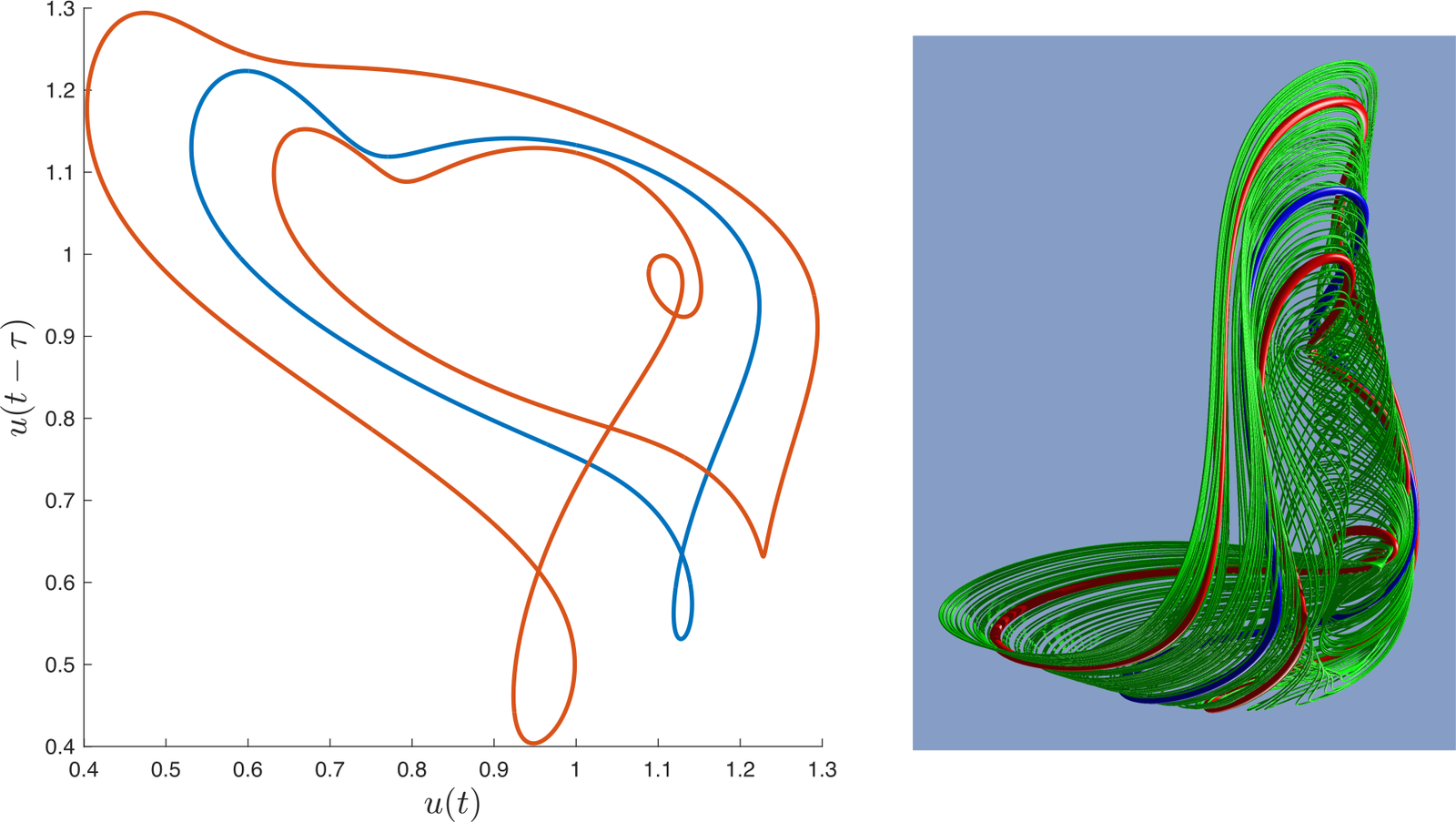
In [52], we develop a general computer-assisted method to prove the existence of periodic solutions of delay differential equations. It applies to systems with any number of delays, both backward and forward in time. Non-polynomial nonlinearities are handled by introducing auxiliary variables, which turn the problem into an equivalent polynomial one that can be solved with a fixed point argument in a space of rapidly decaying Fourier coefficients. We showcase the method on the celebrated Mackey–Glass equation, proving the existence of periodic solutions at its classical parameter values.
Rigorous integration of delay equations
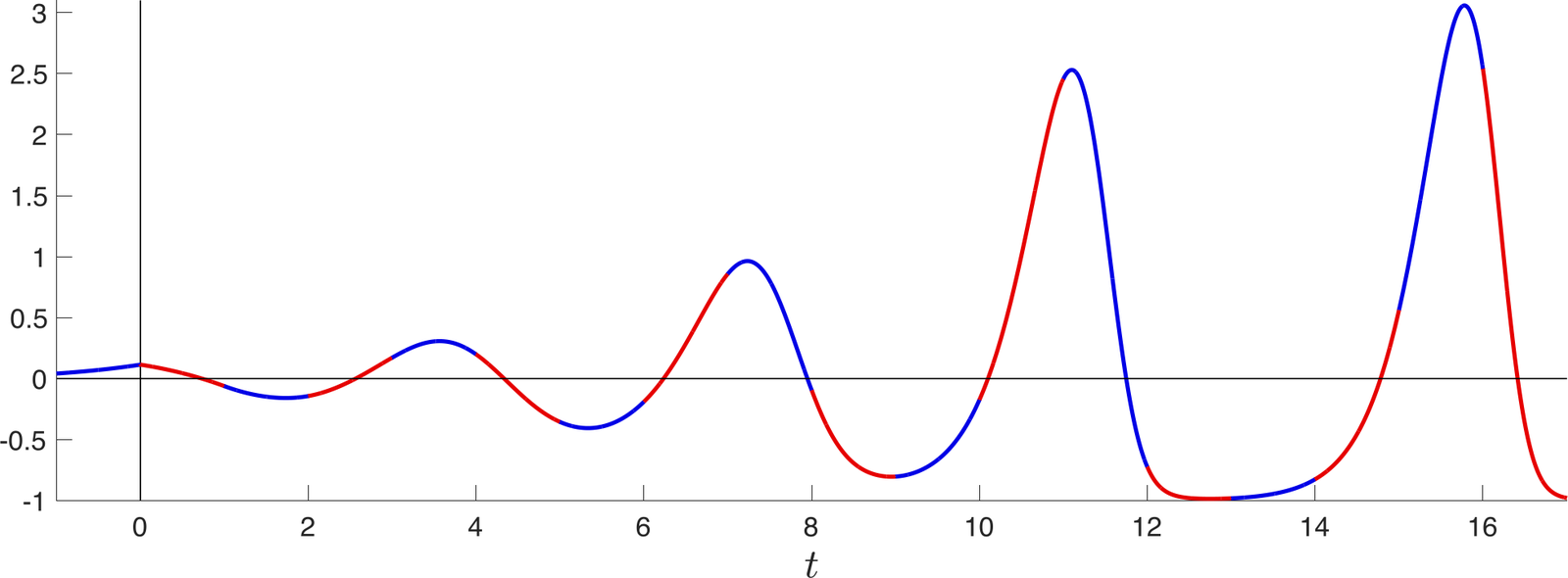
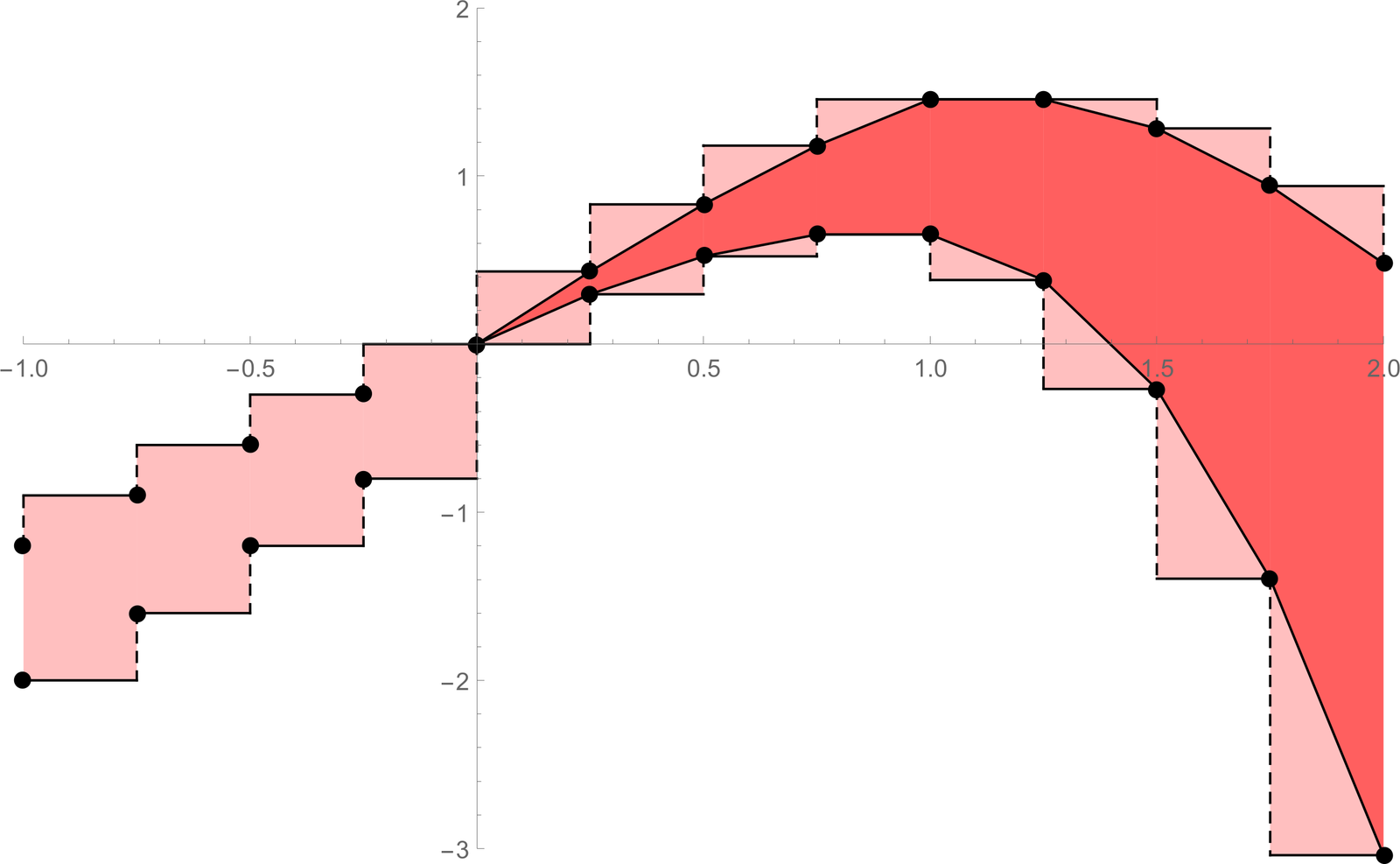
Many questions about delay equations require following solutions forward in time with guaranteed accuracy. In [47], we introduce a rigorous numerical integrator for systems of delay differential equations with a constant delay. Each time step is computed with Chebyshev series and validated by a Newton–Kantorovich argument, which provides error bounds for the solution and also for its derivative with respect to the initial history. This derivative information makes the integrator well suited to the study of periodic orbits, and we use it to prove the existence of periodic solutions of the Mackey–Glass equation.
Eigenvalues and linear stability
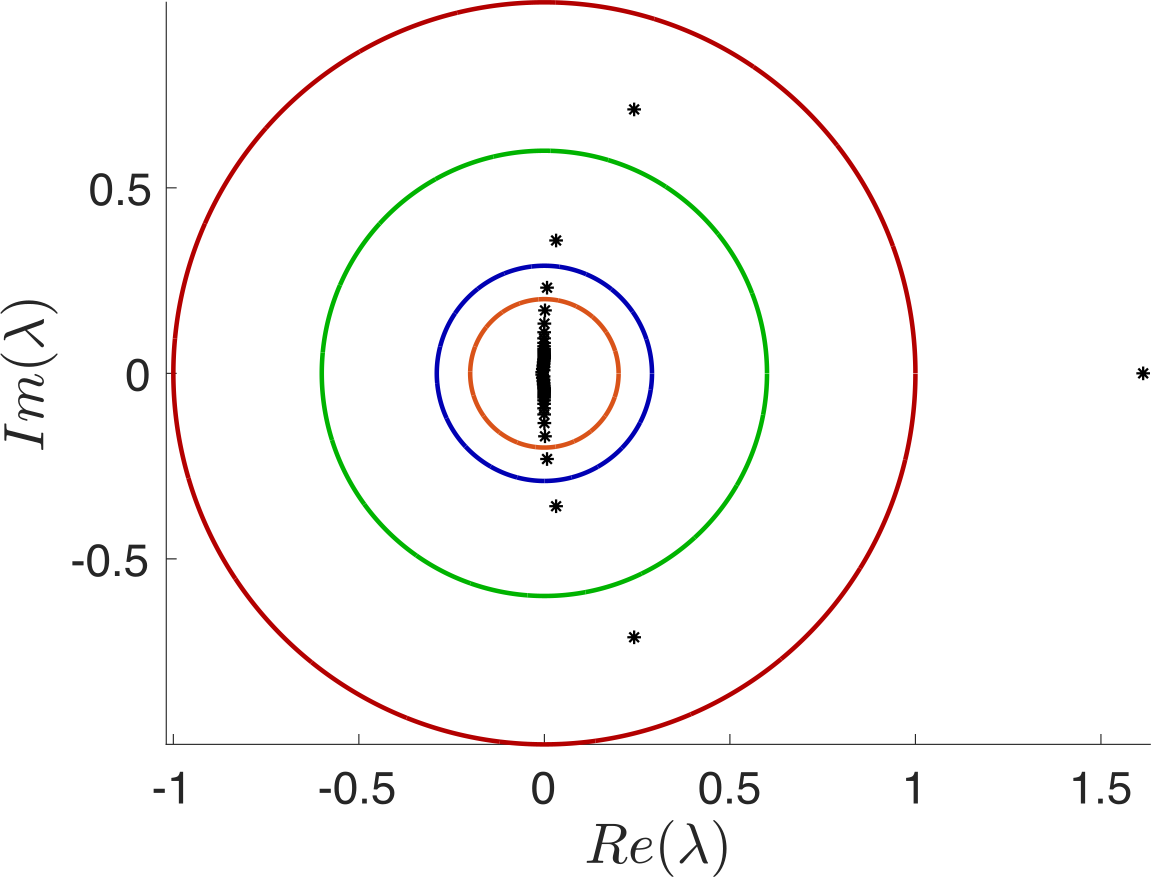
The stability of an equilibrium of a delay equation is governed by infinitely many eigenvalues, which makes rigorous stability analysis delicate. In [45], we develop validated numerical methods to enclose these eigenvalues for systems with one constant delay. Instead of working with the transcendental characteristic equation, we recast the problem as a discrete-time dynamical system expanded in Chebyshev series, which reduces it to questions about sparse infinite matrices handled with the tools of numerical linear algebra. A general implementation provides computer-assisted stability results for several example problems.
The delayed van der Pol oscillator
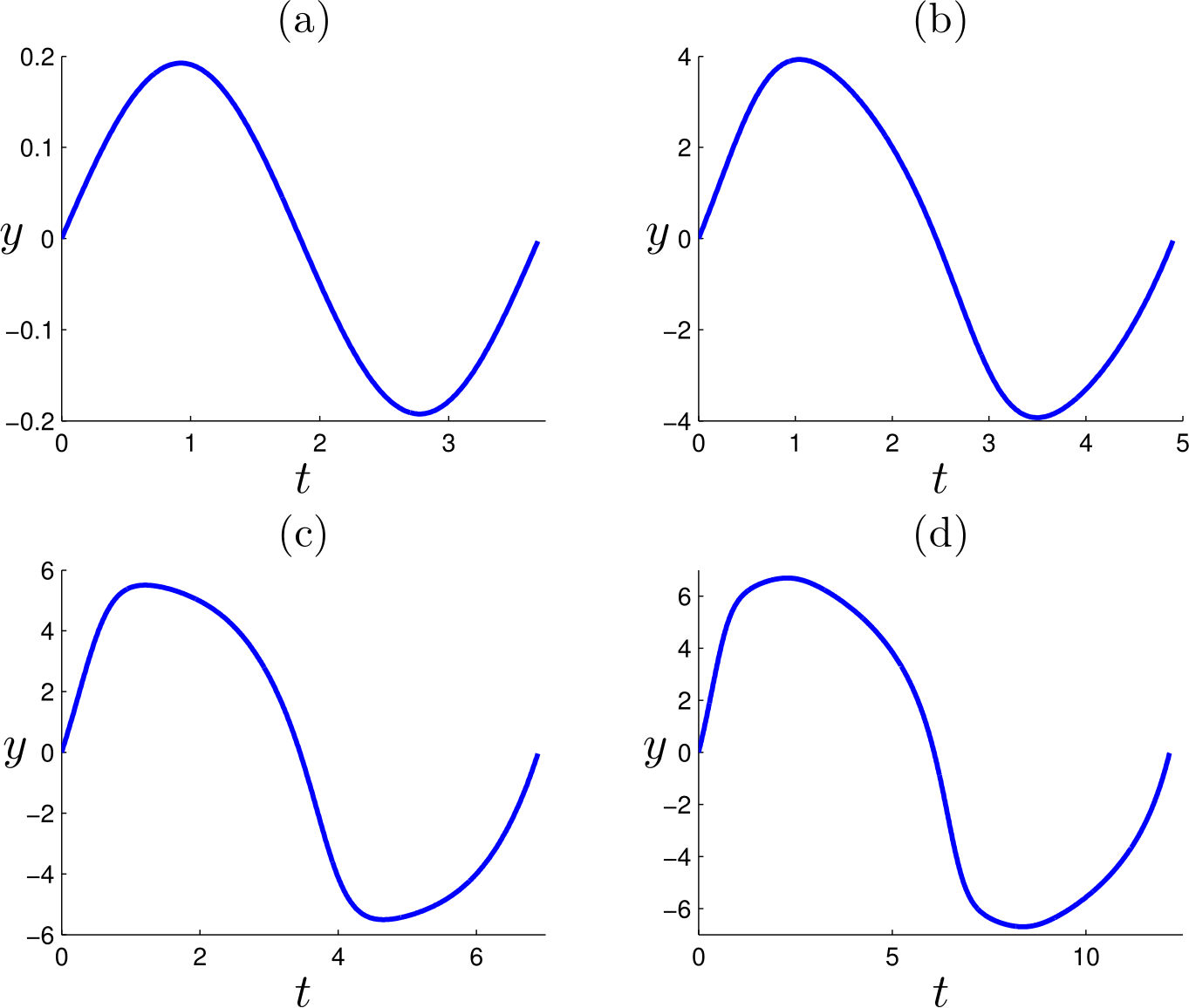
The van der Pol oscillator is a classical model of self-sustained oscillations, and adding a delay to its restoring force leads to much richer dynamics. In [34], we prove the existence of several rapidly and slowly oscillating periodic solutions of a delayed van der Pol equation. The proofs combine careful pen-and-paper estimates, the contraction mapping theorem and computations in interval arithmetic. These results extend the existence theory obtained by Nussbaum [Ann. Mat. Pura Appl. 101 (1974)] to new solutions and parameter values.
Jones’ conjecture
Building on the validated continuation of [4] (below), we prove in [33] that Wright’s equation has exactly one slowly oscillating periodic solution, up to time translation, for every α ∈ [1.9, 6.0]. The key is to show that every such solution is asymptotically stable, which rules out the coexistence of several of them. A branch-and-bound algorithm first encloses all possible slowly oscillating solutions over the whole parameter range, and their Floquet multipliers are then controlled rigorously. This settles Jones’ conjecture on a large parameter interval.
Multiple time lags
Delay equations with several time lags are much harder to analyze than those with a single delay, and many classical tools no longer apply. In [10], we develop a computational fixed point method that turns a numerical approximation of a periodic solution into a proof of its existence, by combining explicit bounds on the truncation error with the Banach fixed point theorem. As applications, we prove that a modified Wright equation with two time lags has three coexisting periodic solutions, and we establish several nontrivial periodic solutions of an equation with three time lags.
Slowly oscillating periodic solutions of Wright’s equation
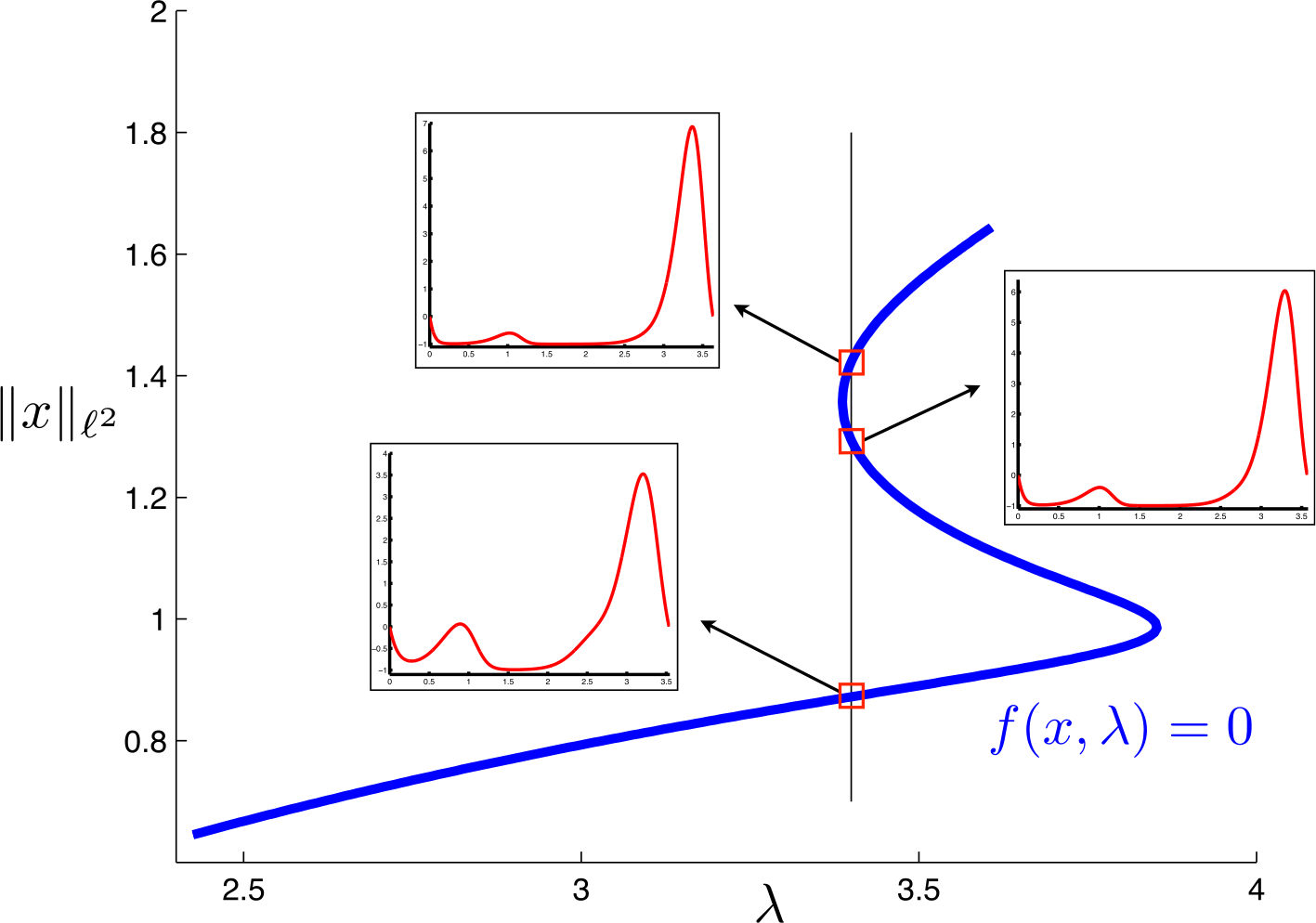
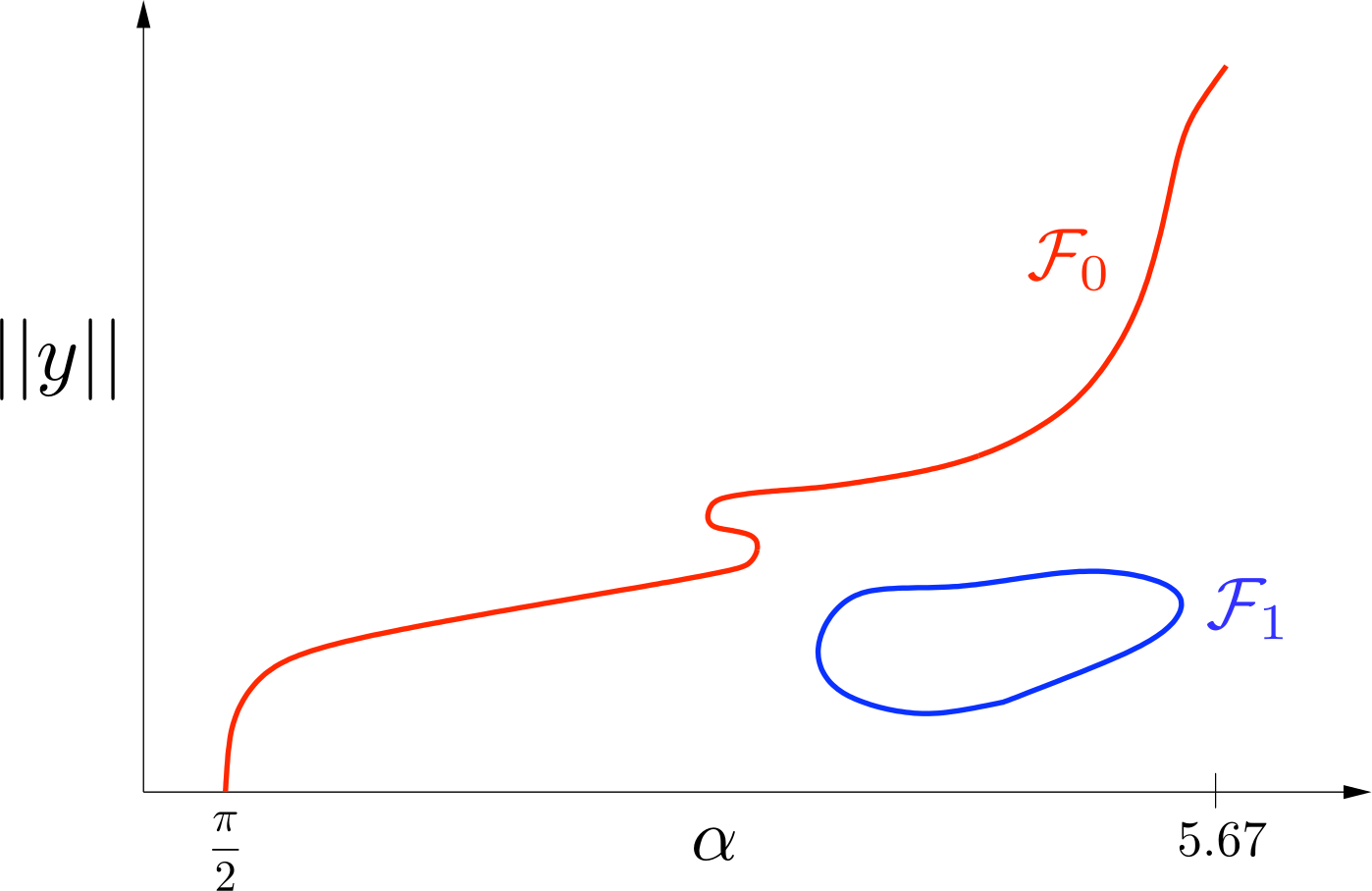
In 1962, Jones observed numerically that solutions of Wright’s equation y′(t) = −αy(t−1)[1+y(t)] seem to converge to a single slowly oscillating periodic solution (SOPS), and conjectured that this solution is unique for every α > π/2. In [4], we recast this conjecture as a statement about a global branch of SOPS and compute a large part of this branch rigorously using validated continuation. We prove that this part of the branch has no fold point, which gives a first partial answer to the reformulated conjecture.
Related publications
- [67]Numerical computation of transverse homoclinic orbits for periodic solutions of delay differential equationsO. Hénot, J.-P. Lessard and J.D. Mireles JamesSIAM Journal on Applied Dynamical Systems, 22(4): 3093–3129, 2023
- [64]Persistence of periodic orbits under state-dependent delayed perturbations: computer-assisted proofsJ. Gimeno, J.-P. Lessard, J.D. Mireles James and J. YangSIAM Journal on Applied Dynamical Systems, 22(3): 1743–1779, 2023
- [53]Parameterization of unstable manifolds for DDEs: formal series solutions and validated error boundsO. Hénot, J.-P. Lessard and J.D. Mireles JamesJournal of Dynamics and Differential Equations, 34(2): 1285–1324, 2022
- [52]A general method for computer-assisted proofs of periodic solutions in delay differential problemsJ.B. van den Berg, C. Groothedde and J.-P. LessardJournal of Dynamics and Differential Equations, 34(2):853–896, 2022
- [47]A rigorous implicit C1 Chebyshev integrator for delay equationsJ.-P. Lessard and J.D. Mireles JamesJournal of Dynamics and Differential Equations, 33(4): 1959–1988, 2021
- [45]A functional analytic approach to validated numerics for eigenvalues of delay equationsJ.-P. Lessard and J.D. Mireles JamesJournal of Computational Dynamics, 7(1): 123–158, 2020
- [34]Rapidly and slowly oscillating periodic oscillations of a delayed van der Pol oscillatorG. Kiss and J.-P. LessardJournal of Dynamics and Differential Equations, 29(4): 1233–1257, 2017
- [33]Stability and uniqueness of slowly oscillating periodic solutions to Wright's equationJ. Jaquette, J.-P. Lessard and K. MischaikowJournal of Differential Equations, 263(11): 7263–7286, 2017
- [10]Computational fixed point theory for differential delay equations with multiple time lagsG. Kiss and J.-P. LessardJournal of Differential Equations, 252 (4): 3093–3115, 2012
- [4]Recent advances about the uniqueness of the slowly oscillating periodic solutions of Wright's equationJ.-P. LessardJournal of Differential Equations, 248 (5): 992–1016, 2010