Research / Ordinary differential equations
Computer-Assisted Proofs in ODEs
I am also very interested in developing rigorous computational techniques for ODEs, as they serve as good approximations for the dynamics of dissipative PDEs. Much of this effort goes into computer-assisted methods to prove existence of dynamical objects in ODEs: periodic orbits, stable and unstable manifolds of equilibria and periodic orbits, connecting orbits, solutions of boundary value problems, and bifurcations.
Two-cycles in spatial ecology
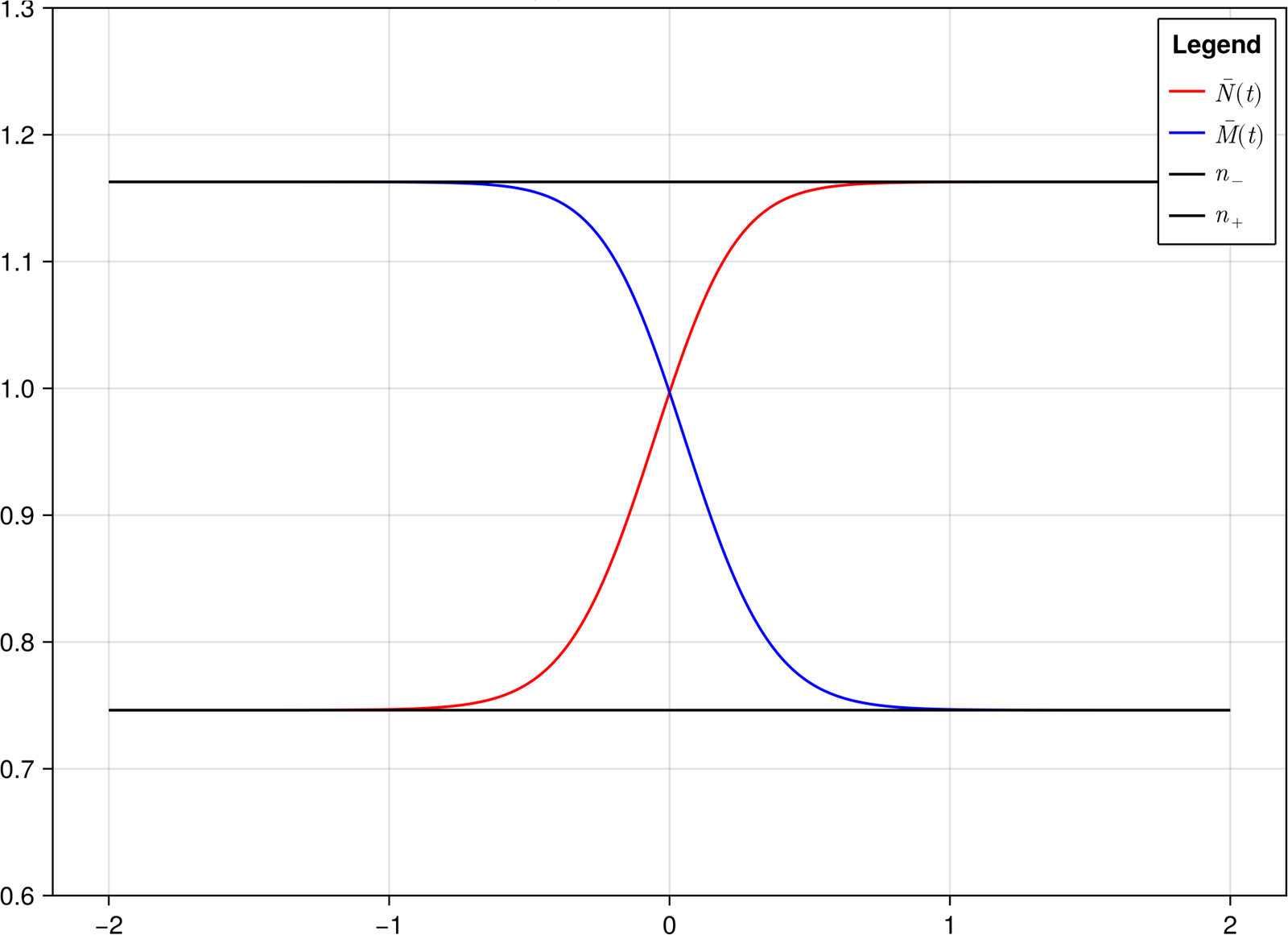
Integrodifference equations describe populations that grow and disperse in discrete generations. In [80], we prove the existence of a spatially inhomogeneous 2-cycle in an integrodifference equation with a Laplace dispersal kernel and logistic growth, a model first studied by Kot. This 2-cycle connects two nontrivial fixed points of the second iterate of the logistic map, in the non-chaotic regime. We also give strong evidence that a similar 2-cycle, observed numerically by Bourgeois, Leblanc and Lutscher for the Ricker growth function, can be proven in the same way, and numerical evidence that both cycles are spectrally stable.
Robustness of neural network controllers
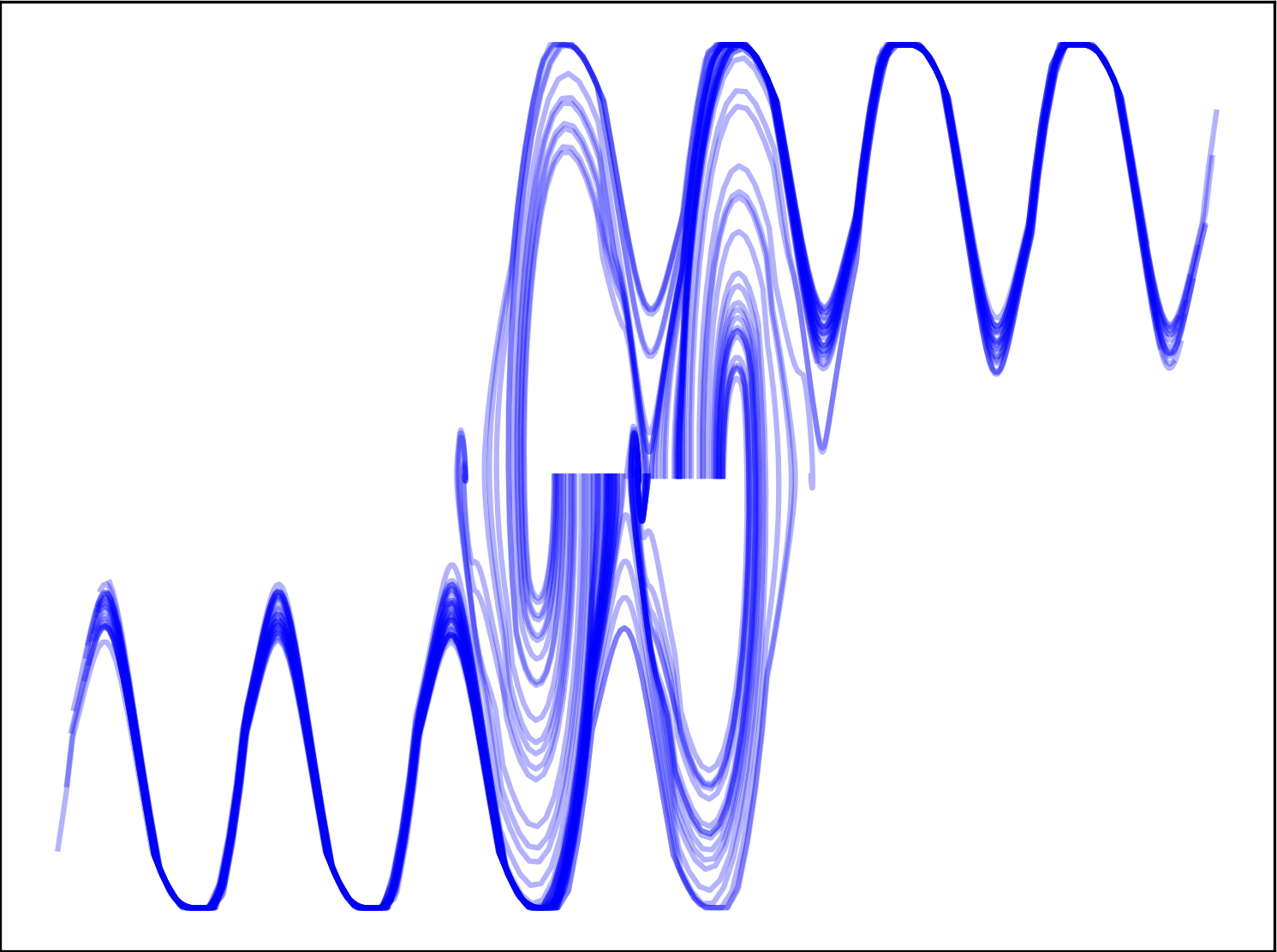
Neural network controllers trained by reinforcement learning can achieve high average performance while hiding undesirable behavior. In [65], we study such controllers for simple benchmark problems, together with their simplified and symbolic versions. We find that a controller with a high mean return can still generate an abundance of persistent low-return solutions, which an adversary could exploit, and that simpler controllers tend to have more of them. We provide an algorithm for a systematic robustness study, and use computer-assisted proofs to establish persistent solutions and, in some cases, periodic orbits.
Saddle-type blow-up solutions
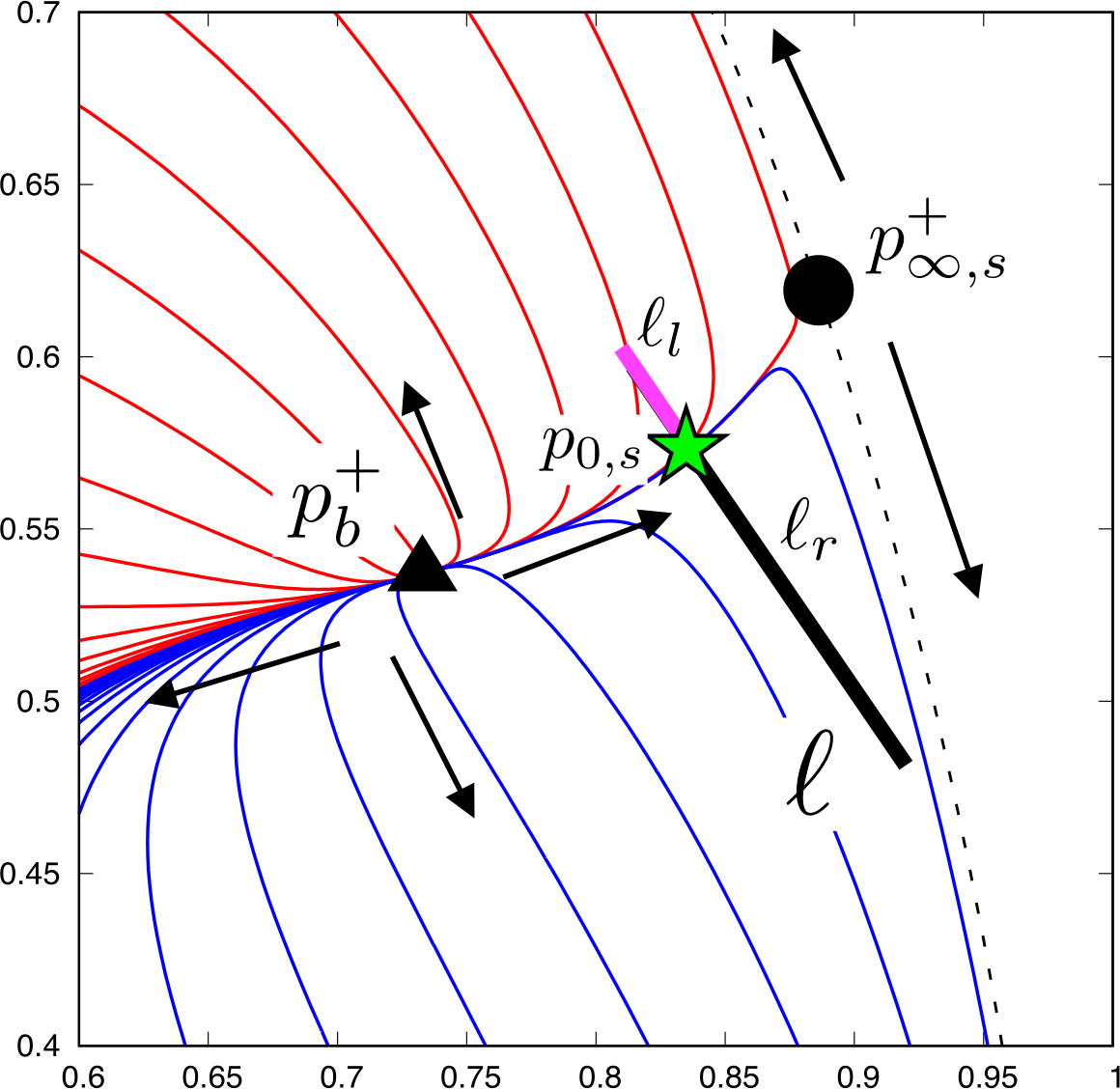
Some solutions of differential equations blow up in finite time, and those that are unstable under perturbations of the initial data are particularly delicate to capture. In [63], we study such saddle-type blow-up solutions by compactifying phase space, so that they become trajectories on stable manifolds of saddle equilibria at infinity. Computer-assisted proofs then give a global picture organized by both global-in-time and blow-up solutions. This reveals intrinsic features of these blow-ups, such as the smooth dependence of the blow-up time on the initial data and their role as separatrices in phase space.
Periodic orbits in cosmology
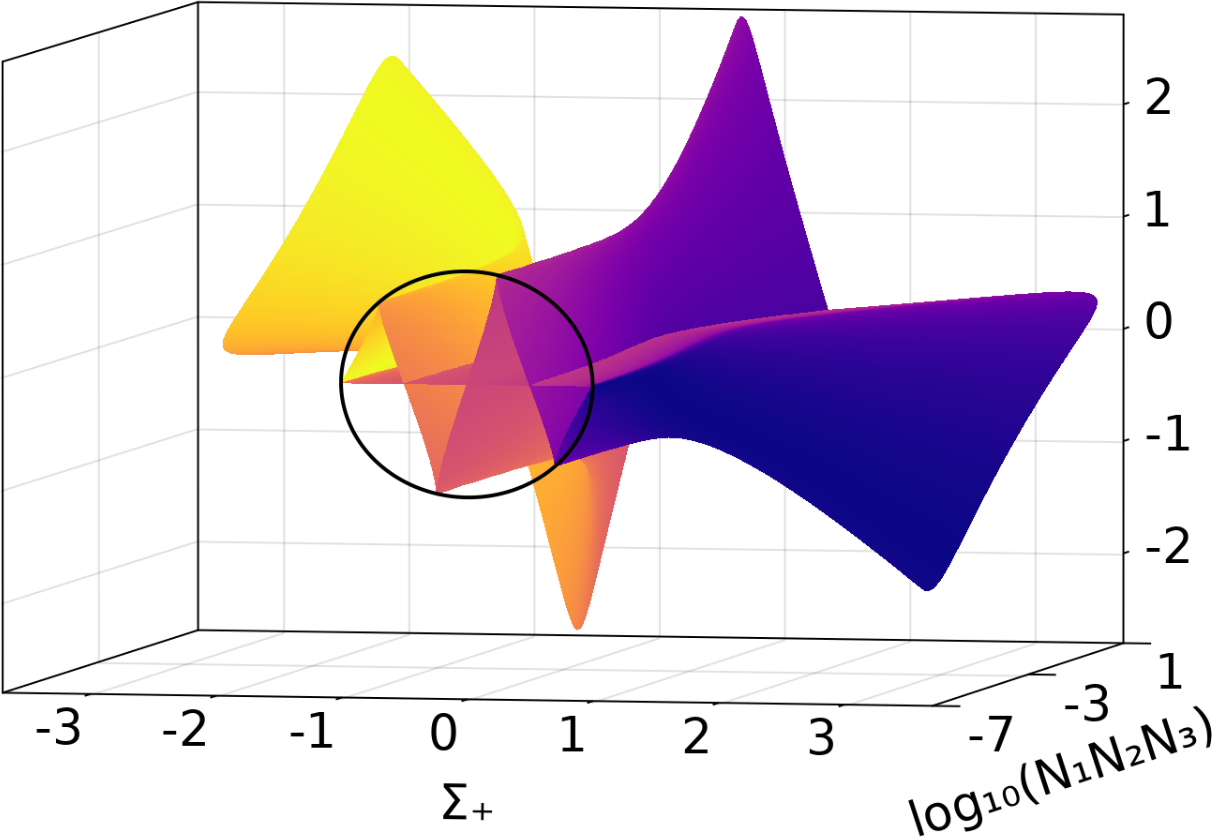
Hořava–Lifshitz models are modifications of General Relativity that depend on a parameter, with General Relativity recovered at a particular value. In [62], we describe the dynamics of spatially homogeneous models in an extremal case, which display the classical hierarchy of Bianchi types. For Bianchi types VIII and IX, we use computer-assisted proofs to establish periodic orbits far from the Mixmaster attractor. This reveals a new behavior that is not captured by the usual picture of such cosmological models as sequences of bouncing Kasner-like states.
Stable and unstable manifolds of periodic orbits
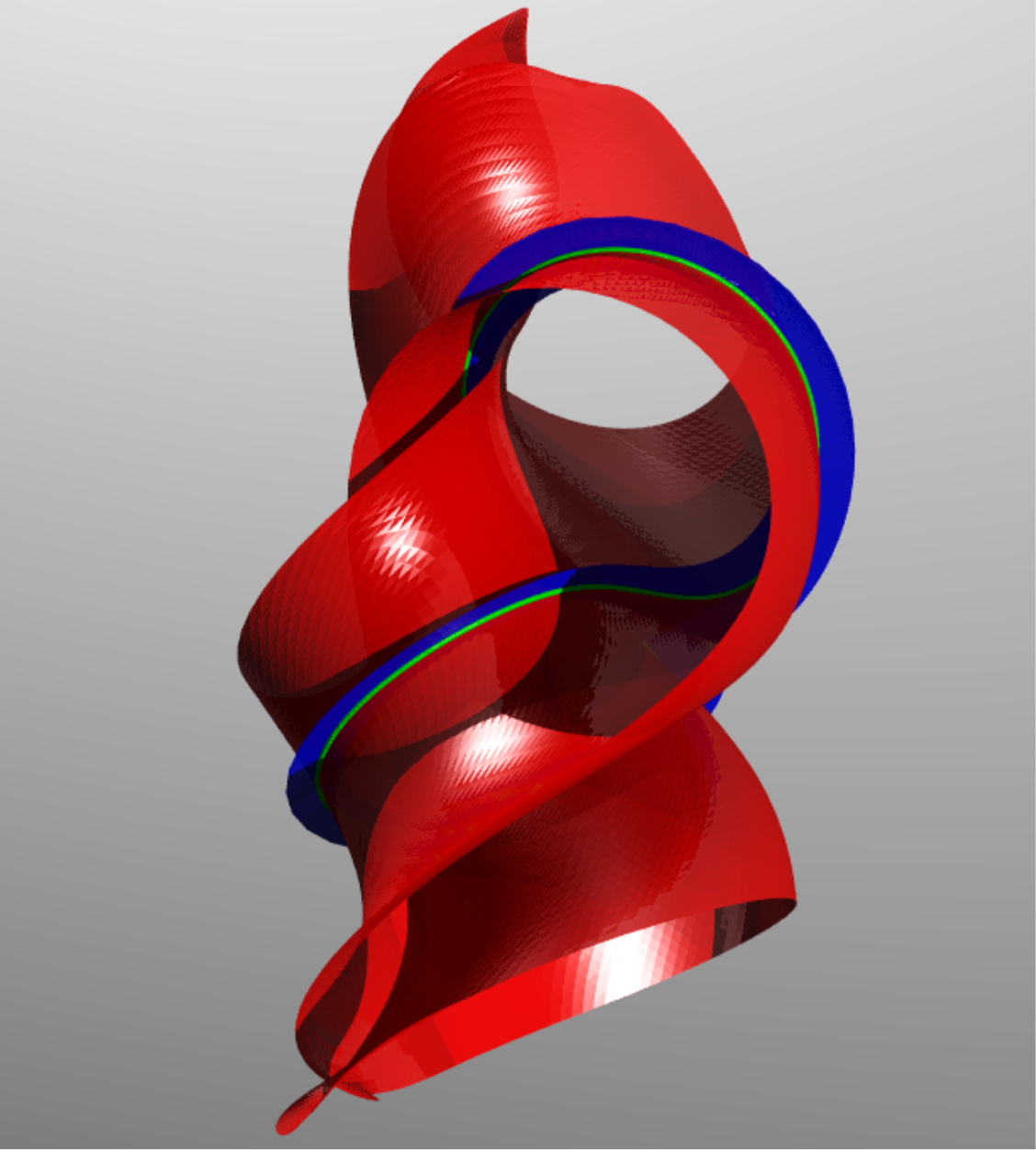
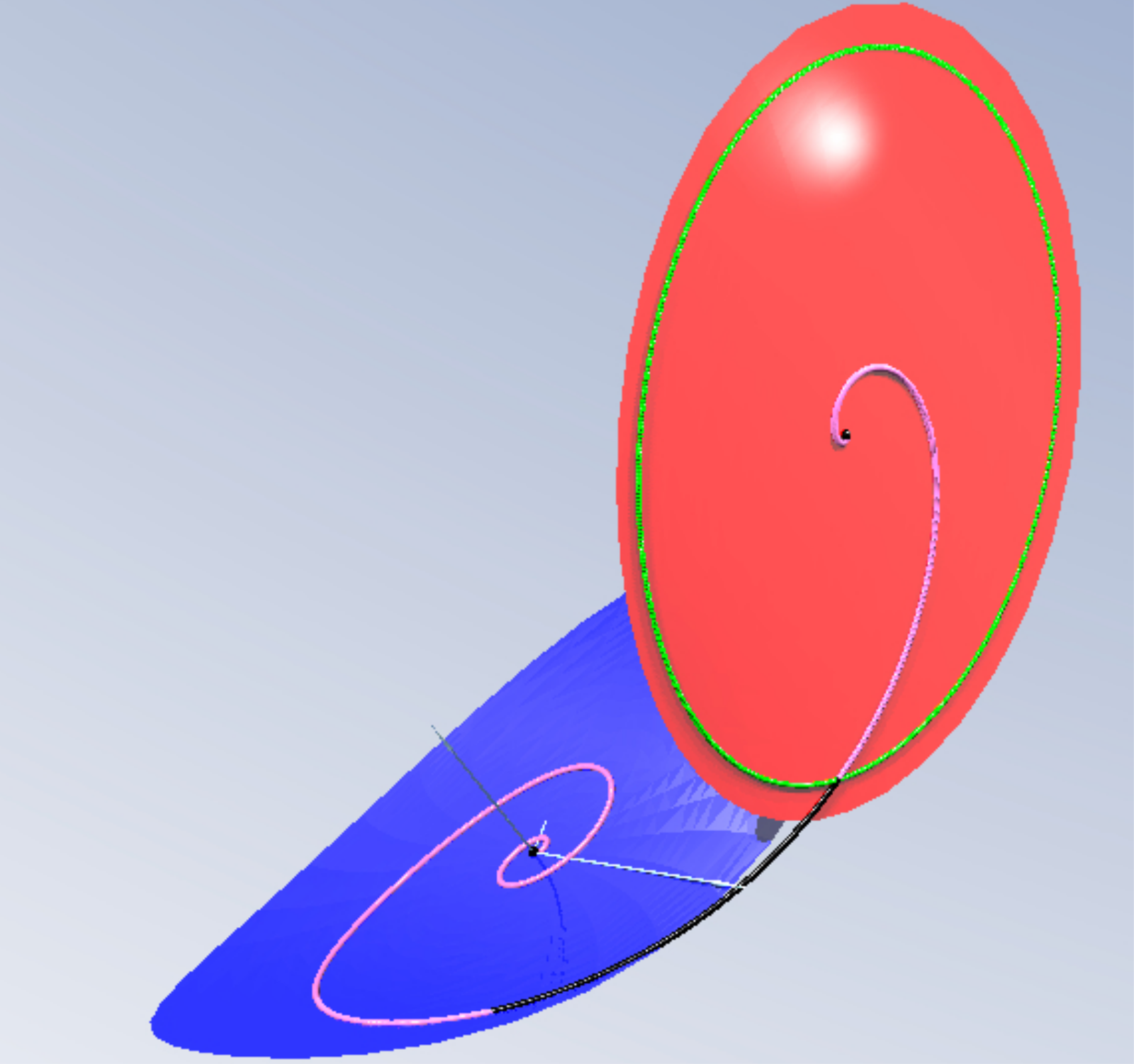
Invariant manifolds attached to periodic orbits organize the dynamics nearby. In [18], we compute Fourier–Taylor expansions of these manifolds with the parameterization method, exploiting the Floquet normal form for efficiency; the method gives both the manifold and the dynamics on it, without numerical integration. In [40], we prove an a posteriori theorem that provides mathematically rigorous error bounds for these high-order expansions, even far from the periodic orbit, where no a priori theory applies. We validate two-dimensional manifolds in ℝ3 and a three-dimensional manifold in ℝ4.
A priori bootstrap
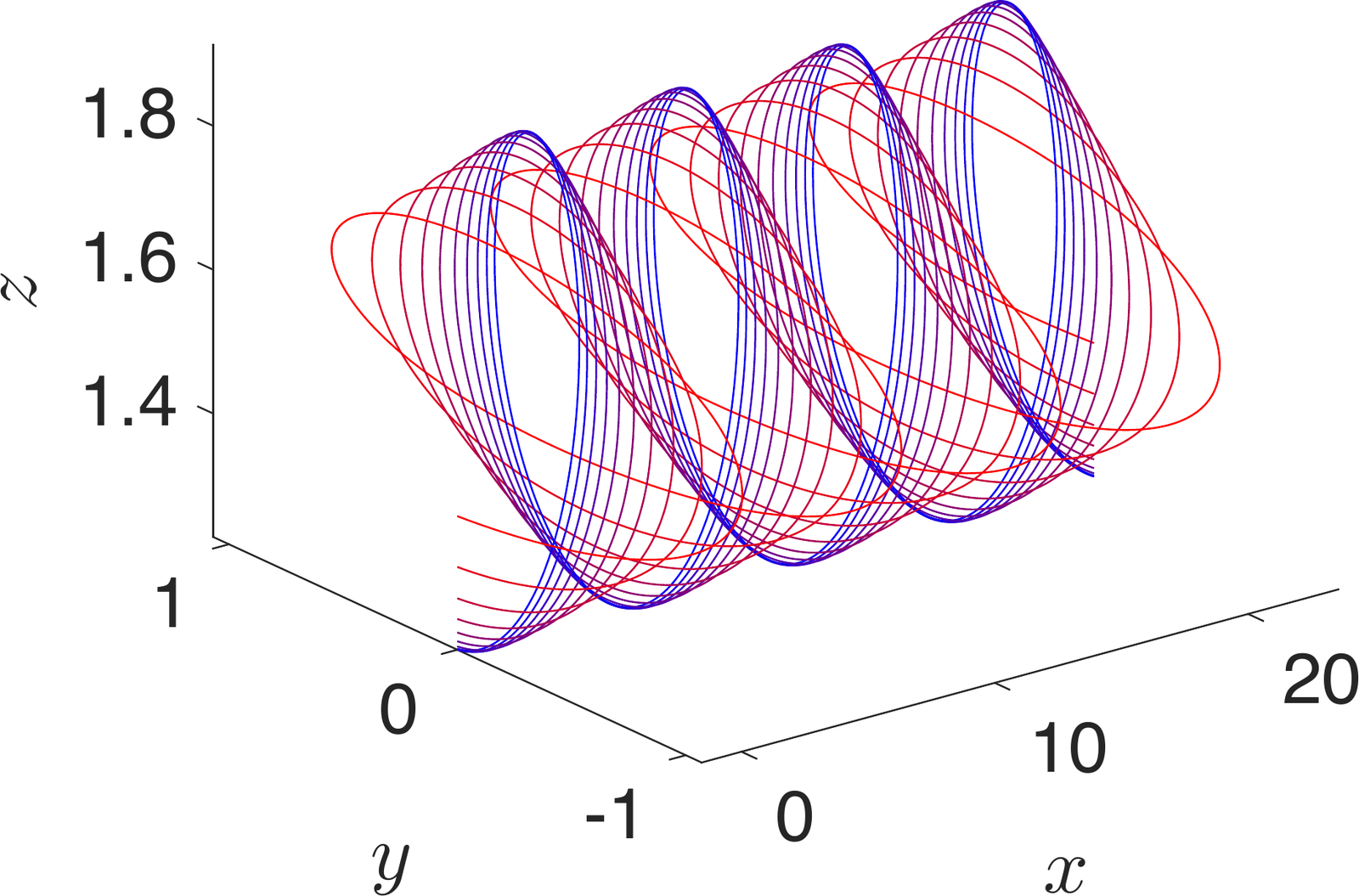
In [38], we introduce a method based on piecewise polynomial interpolation to rigorously enclose solutions of nonlinear ODEs with general nonlinearities. Using a technique we call a priori bootstrap, solving the ODE becomes the search for a fixed point of a high-order smoothing Picard-like operator, whose existence is proved with a Newton–Kantorovich argument. For the Lorenz system, we solve initial value problems and prove the existence of periodic and connecting orbits at the classical parameter values, and for ABC flows, we prove the existence of ballistic spiral orbits.
Automatic differentiation and the three-body problem
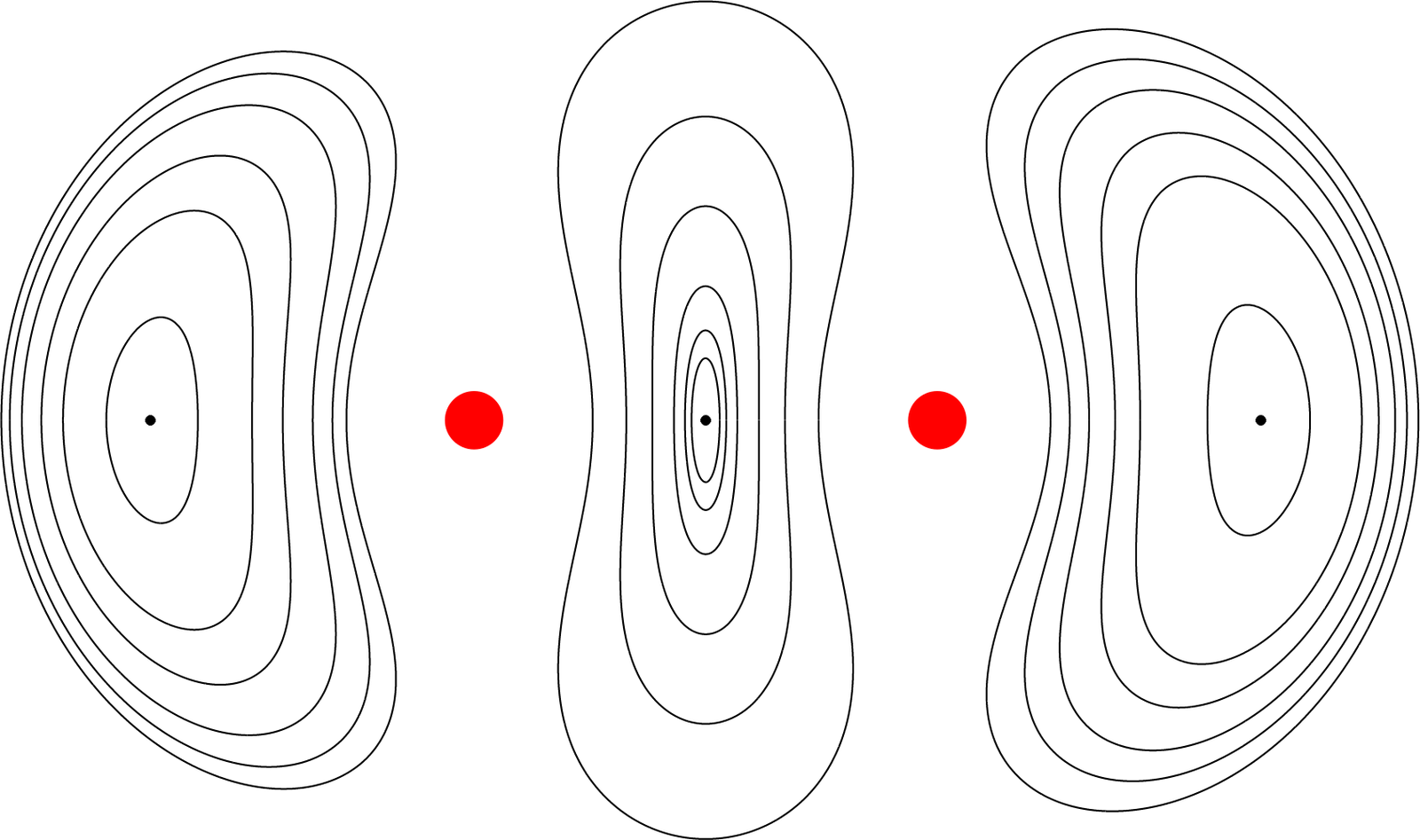
Many differential equations of interest have non-polynomial nonlinearities, which complicate computer-assisted proofs. In [28], we use ideas from automatic differentiation to rewrite such equations as larger systems with only polynomial nonlinearities. Periodic orbits of the augmented system are then validated using Fourier series in a space of analytic functions. As an application, we obtain computer-assisted proofs for the classical Lyapunov family of periodic orbits in the planar circular restricted three-body problem.
Analytic solutions and Chebyshev series
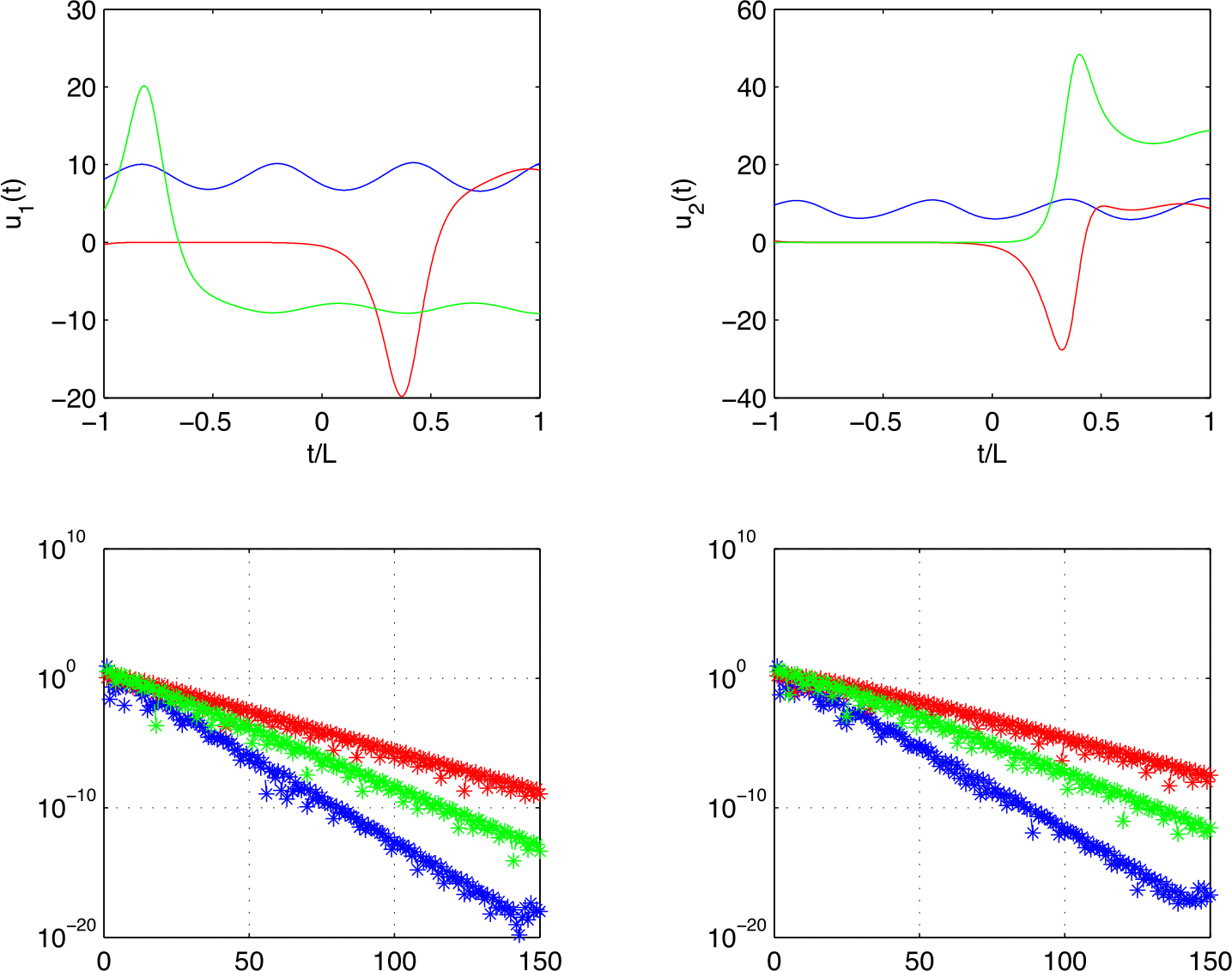
In [27], we adapt the radii polynomial approach, a flexible tool for computer-assisted proofs, to the space of analytic functions, and illustrate it on equilibria of the Swift–Hohenberg equation and periodic orbits of the Lorenz equations. In [15], we use Chebyshev series to rigorously solve initial and boundary value problems for analytic vector fields. As applications, we solve initial value problems in the Lorenz equations and prove the existence of symmetric connecting orbits in the Gray–Scott equation, using a boundary condition in the stable manifold.
Maximizing the image of the stable and unstable manifolds
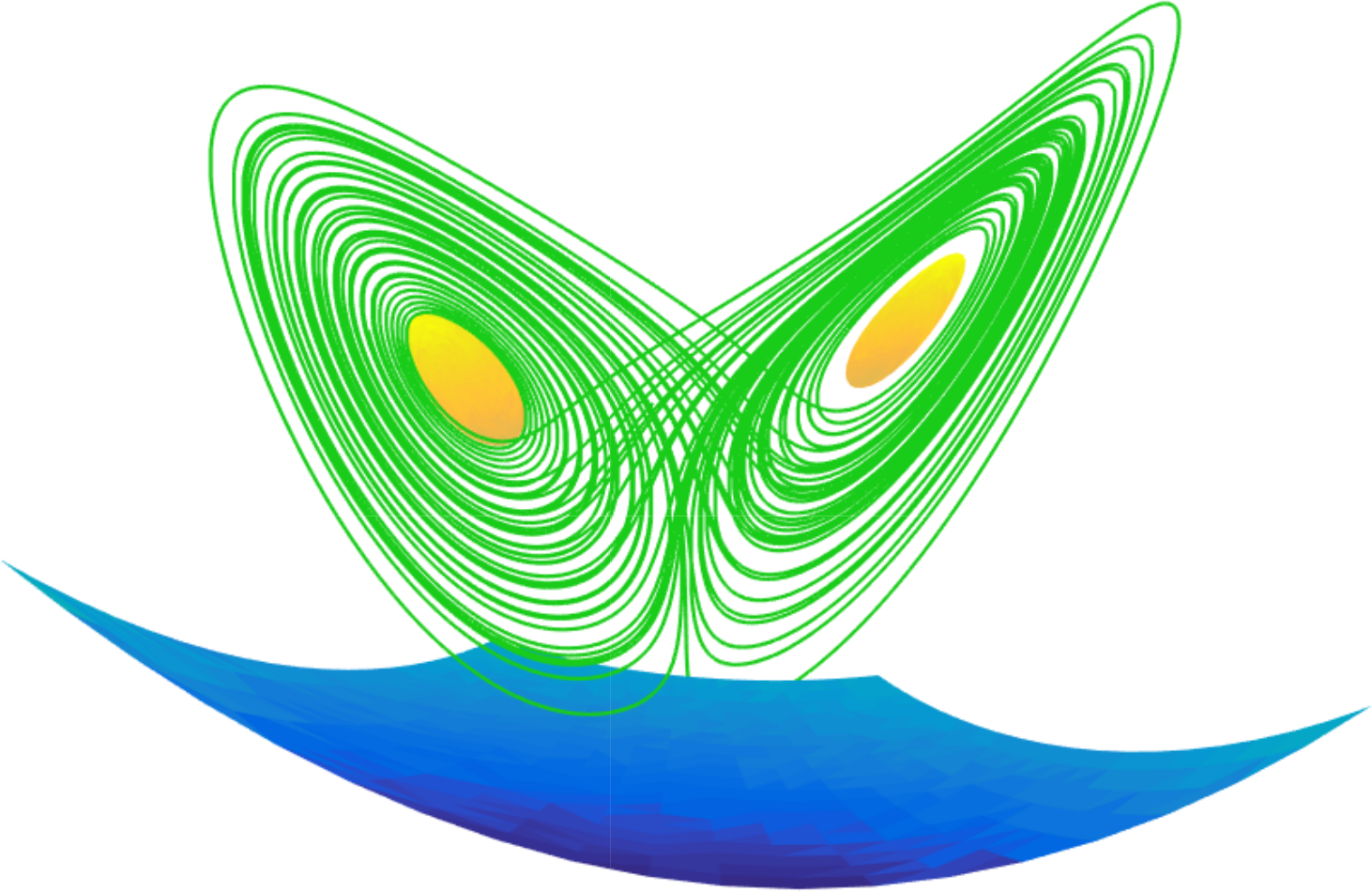
High-order polynomial expansions of local stable and unstable manifolds are only useful if they describe a large part of the manifold. In [25], we develop automatic procedures that compute such expansions with validated error bounds while maximizing the size of their image. The key observation is that these bounds depend heavily on how the eigenvectors are scaled, a dependence that we exploit systematically. Applications include the visualization of invariant manifolds in the Lorenz and FitzHugh–Nagumo systems and an automatic continuation scheme for manifolds in a suspension bridge problem.
Piecewise-smooth systems
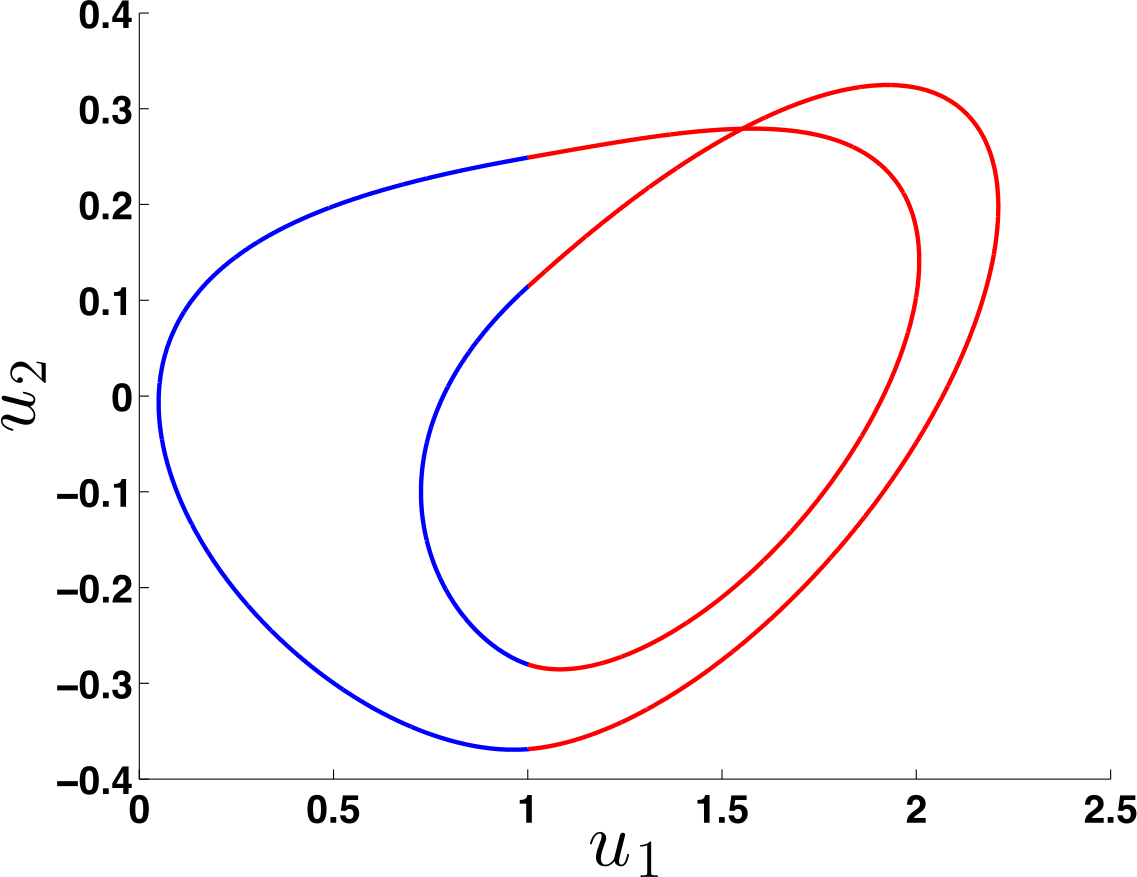
Piecewise-smooth systems, such as mechanical systems with friction or electrical circuits with switches, fall outside the scope of classical smooth theory. In [24], we develop a rigorous computational method, based on Chebyshev series, to prove the existence of crossing periodic orbits of continuous and discontinuous (Filippov) piecewise-smooth systems. We apply it to a nonlinear Filippov system and to Chua’s circuit. We also introduce a general formulation to compute crossing connecting orbits of piecewise-smooth systems.
Floquet normal forms and stable bundles
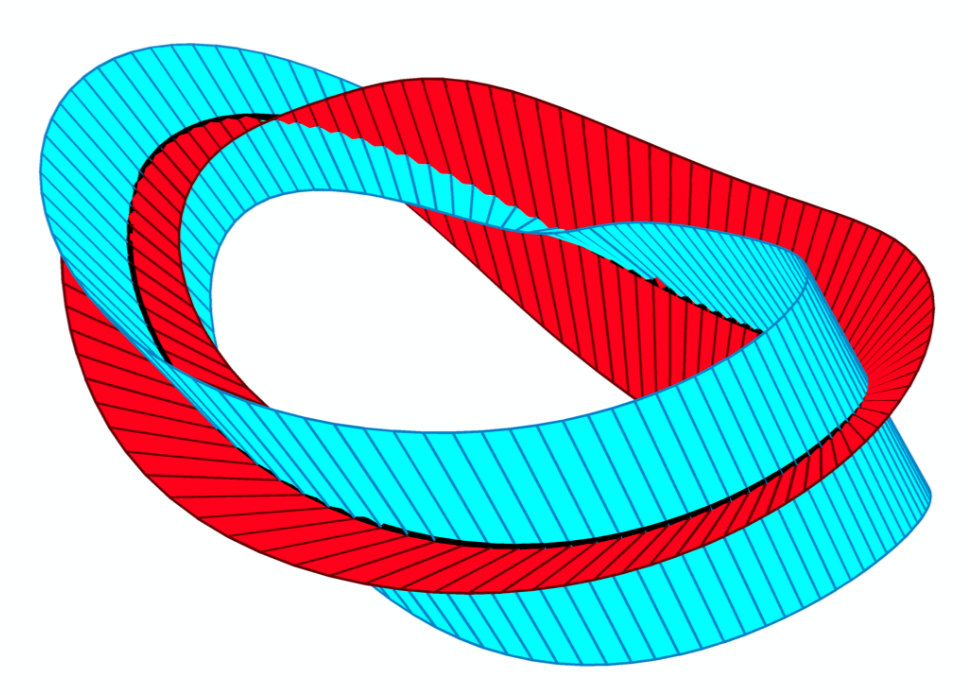
The Floquet normal form Φ(t) = Q(t)eRt splits the fundamental matrix solution of a linear system with periodic coefficients into a periodic part and an exponential part. In [12], we compute this decomposition rigorously by solving simultaneously for R and for the Fourier coefficients of Q with a fixed point argument, without integrating the equation. We use it to construct stable and unstable bundles of periodic orbits in the Lorenz equations and the ζ3-model. In [23], we validate the Floquet normal form in the space of analytic functions.
Blow-up profiles in fourth order ODEs
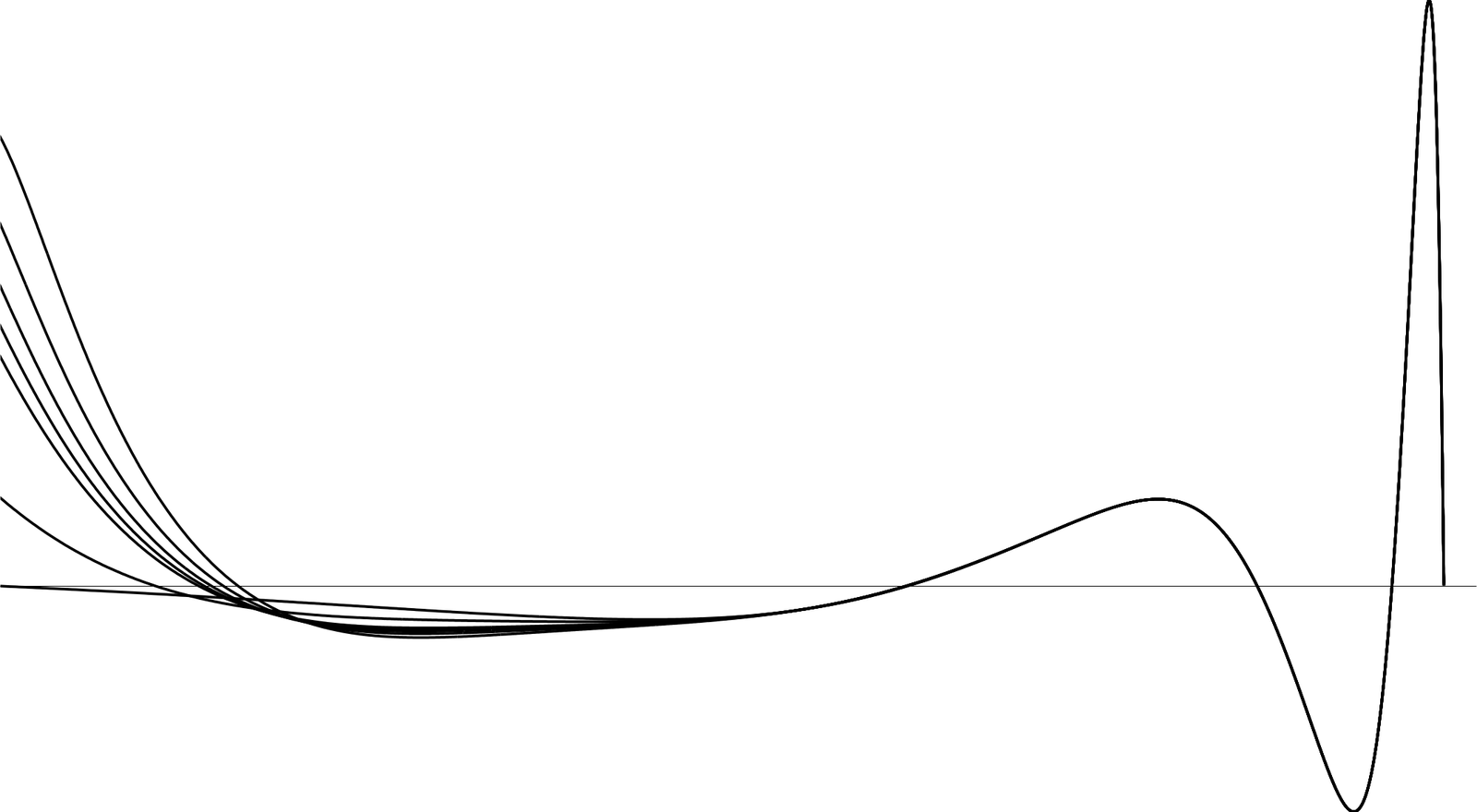
Nontrivial solutions of the fourth-order equation u′′′′ + κu′′ + f(u) = 0, also known as the extended Fisher–Kolmogorov or Swift–Hohenberg equation, blow up in finite time with large oscillations. Understanding the profile of this blow-up is important, for instance, in the study of suspension bridges. In [20], we describe this blow-up profile in detail. The key idea is to relate it to the existence of periodic solutions of an auxiliary equation, which we establish with a computer-assisted proof.
Tridiagonal dominant operators
Computer-assisted proofs usually rely on the linear part of the problem being diagonally dominant, a property that fails for many equations of interest. In [19], we develop a method to solve infinite-dimensional nonlinear problems whose linear part is instead tridiagonal dominant. The main difficulty is to construct a good approximate inverse of the derivative at a numerical solution, and we give practical ways to do so. This provides a new rigorous method to prove the existence of solutions of nonlinear operators with a tridiagonal dominant linear part.
The Ginzburg–Landau model of superconductivity
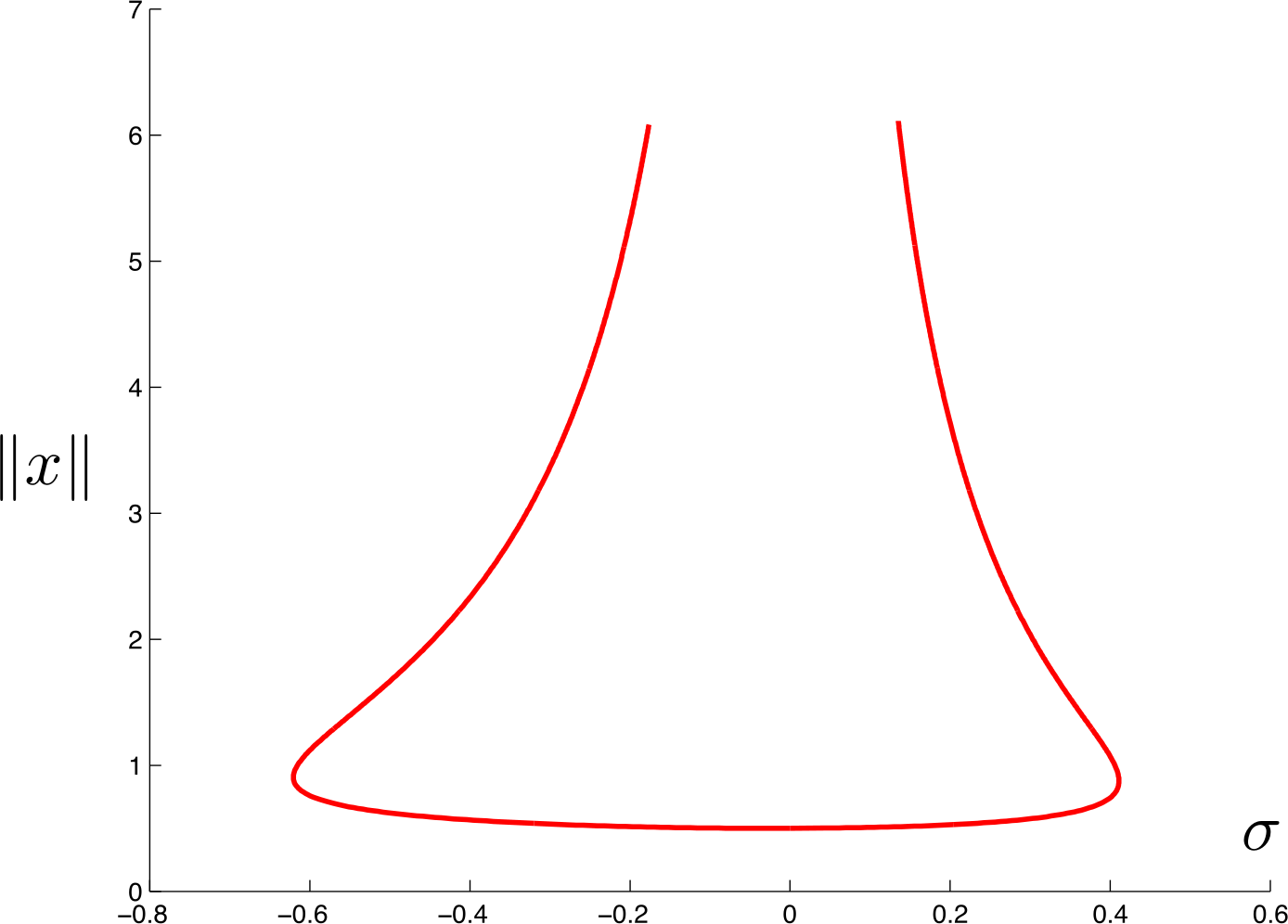
The Ginzburg–Landau model is a classical description of superconductivity. In [17], we settle a thirty-year-old conjecture of Seydel [Numer. Math. 41 (1983)] by proving that the Euler–Lagrange equations of the one-dimensional model have as many as seven coexisting nontrivial solutions. The solutions are recast as fixed points of a Newton-like operator on a space of rapidly decaying Chebyshev coefficients, and their existence near numerical approximations follows from analytic estimates and the contraction mapping theorem.
Transverse connecting orbits
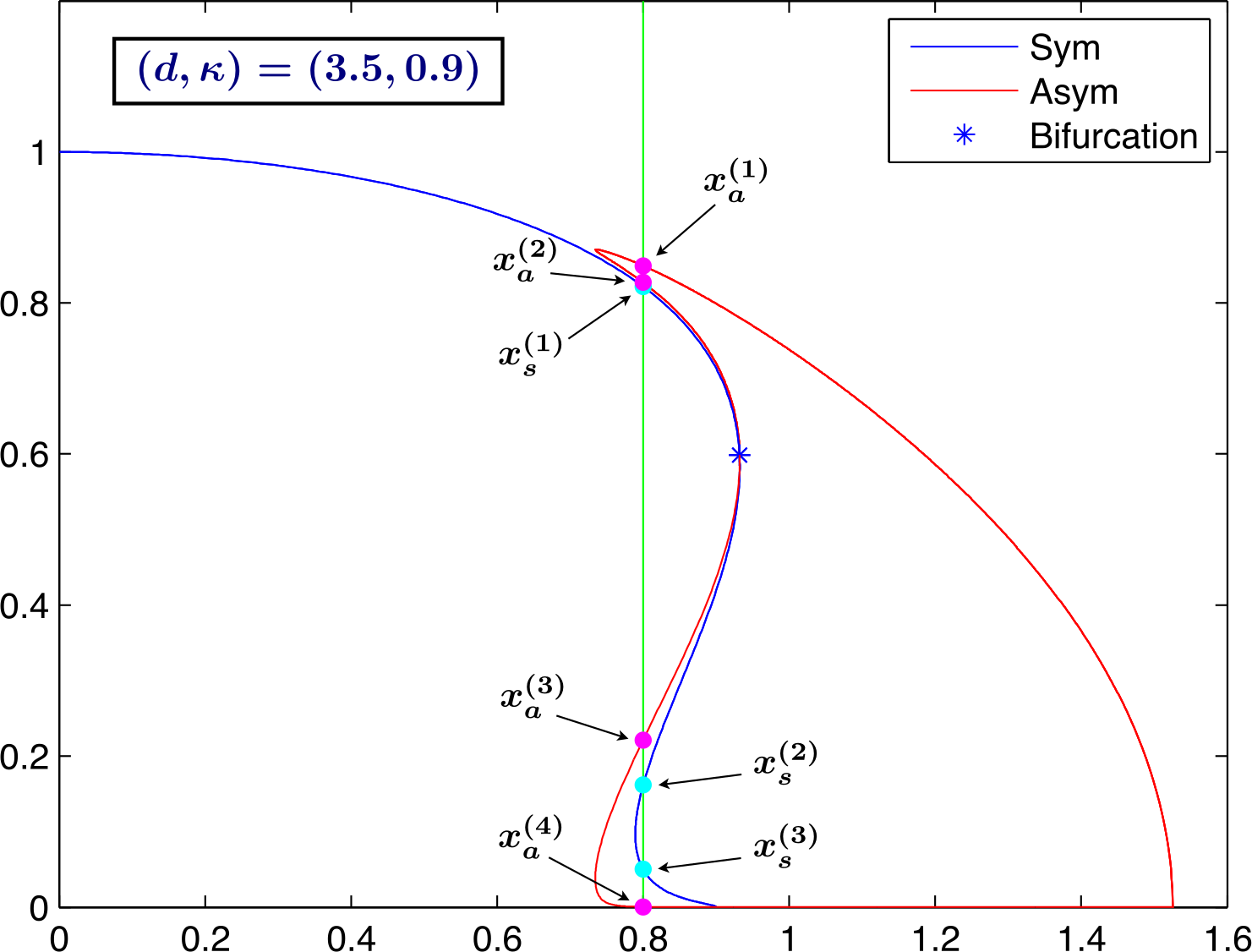
Connecting orbits between equilibria are key to understanding global dynamics. In [16], we introduce a method to prove the existence of saddle-to-saddle connections for vector fields. We first compute high-order parameterizations of the local stable and unstable manifolds. When these local manifolds intersect, the connection is validated directly; otherwise, we solve a boundary value problem between them. In both cases, the argument also proves that the manifolds intersect transversally. We apply the method to the Lorenz equations, where we study a pitchfork bifurcation and prove several short and long connections.
Related publications
- [80]Spatially inhomogeneous two-cycles in an integrodifference equation To appearK. Church, K. Constantineau and J.-P. LessardTo appear in SIAM Journal on Applied Dynamical Systems, 2026
- [65]Worrisome properties of neural network controllers and their symbolic representationsJ. Cyranka, K. Church and J.-P. LessardProceedings of the 2023 European Conference on Artificial Intelligence (ECAI 2023), Volume 372, pages 517-525, 2023
- [63]Saddle-type blow-up solutions with computer-assisted proofs: validation and extraction of global natureJ.-P. Lessard, K. Matsue and A. TakayasuJournal of Nonlinear Science, 33(1), Paper No. 46, 2023
- [62]Periodic orbits in Hořava-Lifshitz cosmologiesGeneral Relativity and Gravitation, 55(1), Paper No. 2, 2023
- [40]Parameterization of invariant manifolds for periodic orbits (II): a-posteriori analysis and computer assisted error boundsR. Castelli, J.-P. Lessard and J.D. Mireles JamesJournal of Dynamics and Differential Equations, 30(4): 1525–1581, 2018
- [38]Polynomial interpolation and a priori bootstrap for computer-assisted proofs in nonlinear ODEsM. Breden and J.-P. LessardDiscrete and Continuous Dynamical Systems - Series B, 23(7):2825–2858, 2018
- [28]Automatic differentiation for Fourier series and the radii polynomial approachJ.-P. Lessard, J.D. Mireles James and J. RansfordPhysica D, 334: 174–186, 2016
- [27]Rigorous numerics for analytic solutions of differential equations: the radii polynomial approachA. Hungria, J.-P. Lessard and J.D. Mireles James.Mathematics of Computation, 85(299): 1427–1459, 2016
- [25]Computation of maximal local (un)stable manifold patches by the parameterization methodM. Breden, J.-P. Lessard and J.D. Mireles James.Indagationes Mathematicae, 27(1): 340–367, 2016
- [24]Rigorous numerics for piecewise-smooth systems: a functional analytic approach based on Chebyshev seriesM. Gameiro, J.-P. Lessard and Y. RicaudJournal of Computational and Applied Mathematics, 292, 654–673, 2016
- [23]Analytic enclosure of the fundamental matrix solutionR. Castelli, J.-P. Lessard and J.D. Mireles JamesApplications of Mathematics, 60(6): 617–636, 2015
- [20]Blow-up profile for solutions of a fourth order nonlinear equationL. D'Ambrosio, J.-P. Lessard and A. PuglieseNonlinear Analysis: Theory, Methods and Applications, 121, 280–335, 2015
- [19]Rigorous numerics for nonlinear operators with tridiagonal dominant linear partsM. Breden, L. Desvillettes and J.-P. LessardDiscrete and Continuous Dynamical Systems - Series A, 35 (10), 4765–4789, 2015
- [18]Parameterization of invariant manifolds for periodic orbits (I): efficient numerics via the Floquet normal formR. Castelli, J.-P. Lessard and J.D. Mireles James.SIAM Journal on Applied Dynamical Systems, 14(1), 132–167, 2015
- [17]Coexistence of nontrivial solutions of the one-dimensional Ginzburg-Landau equation: a computer-assisted proofA. Correc and J.-P. Lessard.European Journal of Applied Mathematics, 26(1): 33–60, 2015
- [16]Computer assisted proof of transverse saddle-to-saddle connecting orbits for first order vector fieldsJ.-P. Lessard, J.D. Mireles James and C. Reinhardt.Journal of Dynamics and Differential Equations, 26(2): 267–313, 2014
- [15]Rigorous numerics for nonlinear differential equations using Chebyshev seriesJ.-P. Lessard and C. Reinhardt.SIAM Journal on Numerical Analysis, 52(1): 1–22, 2014
- [12]Rigorous numerics in Floquet theory: computing stable and unstable bundles of periodic orbitsR. Castelli and J.-P. LessardSIAM Journal on Applied Dynamical Systems, 12 (1): 204–245, 2013