![A := matrix([[3, 1, 0, 0, 0, 0, 0], [0, 3, 1, 0, 0, 0, 0], [0, 0, 3, 0, 0, 0, 0], [0, 0, 0, 3, 1, 0, 0], [0, 0, 0, 0, 3, 0, 0], [0, 0, 0, 0, 0, 2, 1], [0, 0, 0, 0, 0, 0, 2]])](imagesC/ExampleC1.gif)
| > | with(linalg): |
| > | #I show a trade secret of how to produce complicated looking matrices having a nice Jordan form |
| > | A:=matrix([[3, 1, 0, 0, 0, 0, 0], [0, 3, 1, 0, 0, 0,0], [0, 0, 3, 0, 0, 0, 0], [0, 0, 0, 3,1, 0, 0], [0, 0, 0, 0, 3, 0, 0], [0, 0, 0, 0, 0, 2, 1], [0, 0, 0, 0, 0, 0, 2]]); |
| > | M:=matrix([[1, 0, 3, 0, 3, 0, 3], [0,1, 1, 1, 1, 1, 1], [0, 0, 1, 0, 3, 0, 3], [0, 0, 0, 1, 1, 1, 1], [0, 0, 0, 0, 1, 1, 1], [0, 0, 0, 0, 0, 1, 3], [0, 0, 0, 0, 0, 0, 1]]); |
![M := matrix([[1, 0, 3, 0, 3, 0, 3], [0, 1, 1, 1, 1, 1, 1], [0, 0, 1, 0, 3, 0, 3], [0, 0, 0, 1, 1, 1, 1], [0, 0, 0, 0, 1, 1, 1], [0, 0, 0, 0, 0, 1, 3], [0, 0, 0, 0, 0, 0, 1]])](imagesC/ExampleC2.gif)
| > | #The fact that M has determinant 1 guarantees it's invertible over Z and so that the overall scrambling we are doing is not too bad numerically |
| > | S:=matrix([[0, 1, 0, 0, 0, 0, 0], [0, 0, 1, 0, 0, 0, 0], [0, 0, 0, 1, 0, 0, 0], [0, 0, 0, 0, 1, 0, 0], [0, 0, 0, 0, 0, 1, 0], [0, 0, 0, 0, 0, 0, 1], [1, 0, 0, 0, 0, 0, 0]]); |
![S := matrix([[0, 1, 0, 0, 0, 0, 0], [0, 0, 1, 0, 0, 0, 0], [0, 0, 0, 1, 0, 0, 0], [0, 0, 0, 0, 1, 0, 0], [0, 0, 0, 0, 0, 1, 0], [0, 0, 0, 0, 0, 0, 1], [1, 0, 0, 0, 0, 0, 0]])](imagesC/ExampleC3.gif)
| > | #S is just a permuation matrix designed to kill the upper diagonal form of the rest of the matrices. And here comes the matrix we'll deal with: |
| > | B:=multiply(M, inverse(S), A, S, inverse(M)); |
![B := matrix([[5, 0, -6, 3, 9, -9, 24], [1, 3, -2, 1, 2, -2, 5], [3, 0, -6, 1, 17, -15, 42], [1, 0, -3, 3, 6, -5, 14], [1, 0, -3, 0, 9, -5, 14], [3, 0, -9, 0, 18, -15, 51], [1, 0, -3, 0, 6, -6, 20]])](imagesC/ExampleC4.gif)
| > | factor(charpoly(B, t));factor(minpoly(B, t)); |
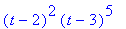
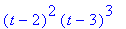
| > | #From this we know we deal with two spaces. Note that we know that there is one Jordan block corresponding to the eigenvalue 2 and it has size 2, however we don't know yet the basis in which we get that block. The situation for 3 is worse. We only know there's one Jordan block of size 3 and the total size is 5. We could have a priori either a (3, 2) situation or a (3, 1, 1) situation. We first deal with the space associated with the factor (t-3)^5. |
| > | L1:=kernel(B-3);nops(L1); |
![L1 := {vector([0, 1, 0, 0, 0, 0, 0]), vector([3, 0, 3, 1, 1, 0, 0])}](imagesC/ExampleC7.gif)

| > | L2:=kernel((B-3)^2);nops(L2); |
![L2 := {vector([3, 0, 1, 0, 0, 0, 0]), vector([6, 0, 0, 0, 0, 1, 0]), vector([0, 1, 0, 0, 0, 0, 0]), vector([-6, 0, 0, 1, 1, 0, 0])}](imagesC/ExampleC9.gif)

| > | L3:=kernel((B-3)^3);nops(L3); |
![L3 := {vector([0, 1, 0, 0, 0, 0, 0]), vector([0, 0, 0, 1, 0, 0, 0]), vector([-6, 0, 0, 0, 1, 0, 0]), vector([6, 0, 0, 0, 0, 1, 0]), vector([3, 0, 1, 0, 0, 0, 0])}](imagesC/ExampleC11.gif)

| > | #We have calculated the dimensions of the kernels and bases. In our notation from class we should have C^3 one dimensional (=5-4), C^2 is two dimensionl(=4-2) and contains (B-3)C^3 and C^1 is 2 dimensional (=dim kernel B-3) and contains (B-3)C^2. We span C^3 using a vector in kernel (B-3)^3 and not in kernel (B_3)^2. We try: |
| > | multiply((B-3)^2, L3[1]); |
![vector([0, 0, 0, 0, 0, 0, 0])](imagesC/ExampleC13.gif)
| > | multiply((B-3)^2, L3[2]); |
![vector([0, 0, 0, 0, 0, 0, 0])](imagesC/ExampleC14.gif)
| > | multiply((B-3)^2, L3[3]); |
![vector([0, 1, 0, 0, 0, 0, 0])](imagesC/ExampleC15.gif)
| > | multiply((B-3)^2, L3[4]); |
![vector([0, -1, 0, 0, 0, 0, 0])](imagesC/ExampleC16.gif)
| > | multiply((B-3)^2, L3[5]); |
![vector([0, 0, 0, 0, 0, 0, 0])](imagesC/ExampleC17.gif)
| > | v3:=vector([-6, 0, 0, 0, 1, 0, 0]); |
![v3 := vector([-6, 0, 0, 0, 1, 0, 0])](imagesC/ExampleC18.gif)
| > | #(Hopefully, when you run Maple again on this example it will indeed choose to include this vector in the basis L3....) |
| > | #Then (B-3)v3 is a vector in kernel (B-3)^2. It is |
| > | Uv3:=multiply(B-3, v3); |
![Uv3 := vector([-3, -4, -1, 0, 0, 0, 0])](imagesC/ExampleC19.gif)
| > | #We are looking for one more vector v2 so that kernel (B-3)^2 is the direct sum of kernel(B-3) and Span((B-3)v3, v2). Namely, for a vector in kernel (B-3)^2 and not in the span of the union of L1 and (B-3)v3. We can find such a vector among L2. We are looking for a vector in L2 so that the matrix below has rank 4. |
| > | matrix([L1[1], L1[2], Uv3, L2[1]]);rank(%); |
![matrix([[0, 1, 0, 0, 0, 0, 0], [3, 0, 3, 1, 1, 0, 0], [-3, -4, -1, 0, 0, 0, 0], [3, 0, 1, 0, 0, 0, 0]])](imagesC/ExampleC20.gif)

| > | matrix([L1[1], L1[2], Uv3, L2[2]]);rank(%); |
![matrix([[0, 1, 0, 0, 0, 0, 0], [3, 0, 3, 1, 1, 0, 0], [-3, -4, -1, 0, 0, 0, 0], [6, 0, 0, 0, 0, 1, 0]])](imagesC/ExampleC22.gif)

| > | matrix([L1[1], L1[2], Uv3, L2[3]]);rank(%); |
![matrix([[0, 1, 0, 0, 0, 0, 0], [3, 0, 3, 1, 1, 0, 0], [-3, -4, -1, 0, 0, 0, 0], [0, 1, 0, 0, 0, 0, 0]])](imagesC/ExampleC24.gif)

| > | matrix([L1[1], L1[2], Uv3, L2[4]]);rank(%); |
![matrix([[0, 1, 0, 0, 0, 0, 0], [3, 0, 3, 1, 1, 0, 0], [-3, -4, -1, 0, 0, 0, 0], [-6, 0, 0, 1, 1, 0, 0]])](imagesC/ExampleC26.gif)

| > | #So we may take (again, provided Maple chooses the list L2 in the same way when you try it out...) |
| > | v2:=vector([6, 0, 0, 0, 0, 1, 0]); |
![v2 := vector([6, 0, 0, 0, 0, 1, 0])](imagesC/ExampleC28.gif)
| > | #At this point we are done with our basis for the t-3 factor. It is |
| > | # U2v3= (B-3)^2v3, Uv3=(B-3)v3, v3, Uv2=(B-3)v2, v2, |
| > | #where |
| > | U2v3:=multiply((B-3)^2, v3); |
![U2v3 := vector([0, -1, 0, 0, 0, 0, 0])](imagesC/ExampleC29.gif)
| > | Uv2:=multiply((B-3), v2); |
![Uv2 := vector([3, 4, 3, 1, 1, 0, 0])](imagesC/ExampleC30.gif)
| > | #The t-2 factor is easier |
| > | H1:=kernel((B-2)^2); |
![H1 := {vector([0, 1, 3, 1, 1, 3, 1]), vector([1, 0, 0, 0, 0, 0, 0])}](imagesC/ExampleC31.gif)
| > | H2:=kernel(B-2); |
![H2 := {vector([3, 1, 3, 1, 1, 3, 1])}](imagesC/ExampleC32.gif)
| > | #We look for a vector in H1 and not in H2. For example, we can take |
| > | w2:=vector([1, 0, 0, 0, 0, 0, 0]); |
![w2 := vector([1, 0, 0, 0, 0, 0, 0])](imagesC/ExampleC33.gif)
| > | Uw2:=multiply(B-2, w2); |
![Uw2 := vector([3, 1, 3, 1, 1, 3, 1])](imagesC/ExampleC34.gif)
| > | #Our basis is then the columns of the matrix |
| > | M:=transpose(matrix([U2v3, Uv3, v3, Uv2, v2, Uw2, w2])); |
![M := matrix([[0, -3, -6, 3, 6, 3, 1], [-1, -4, 0, 4, 0, 1, 0], [0, -1, 0, 3, 0, 3, 0], [0, 0, 0, 1, 0, 1, 0], [0, 0, 1, 1, 0, 1, 0], [0, 0, 0, 0, 1, 3, 0], [0, 0, 0, 0, 0, 1, 0]])](imagesC/ExampleC35.gif)
| > | multiply(inverse(M), B, M); |
![matrix([[3, 1, 0, 0, 0, 0, 0], [0, 3, 1, 0, 0, 0, 0], [0, 0, 3, 0, 0, 0, 0], [0, 0, 0, 3, 1, 0, 0], [0, 0, 0, 0, 3, 0, 0], [0, 0, 0, 0, 0, 2, 1], [0, 0, 0, 0, 0, 0, 2]])](imagesC/ExampleC36.gif)
| > | #DONE!! |