Research / Topological methods
Forcing Theorems via Topological Methods
The advantage of computer-assisted proofs over simulation is that its outcomes can be used as building blocks of mathematics. This is often expressed as forcing theorems: if a certain type of solution exists, then analytic theory implies further properties of the dynamical system, as in the celebrated “period 3 implies chaos”. The hypotheses of such theorems are often impossible to check by hand for a specific system; part of my research combines computer-assisted proofs with topological methods, such as Morse–Conley–Floer theory and braid forcing, to overcome this obstacle.
Homoclinic snaking in dynamical systems
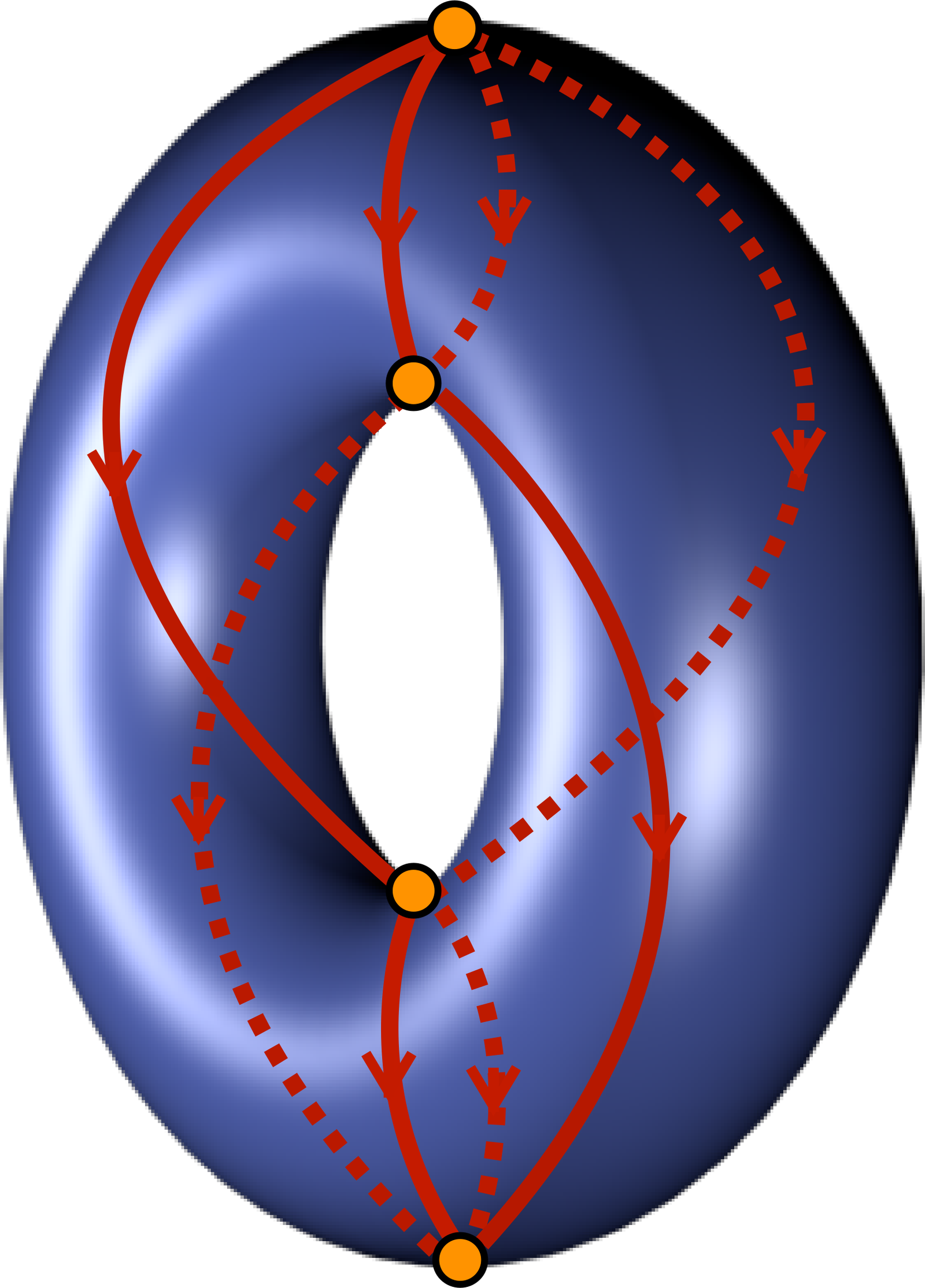
Homoclinic snaking is a widespread phenomenon in pattern-forming systems, in which a branch of localized patterns winds back and forth as the patterns grow. Proving its occurrence away from perturbative regimes is difficult, although a forcing theory reduces the problem to finding patterned front solutions. In [78], we use computer-assisted proofs to find parameterized loops of heteroclinic connections between equilibria and periodic orbits in time-reversible systems. These loops force homoclinic snaking, which we thereby prove in both the Swift–Hohenberg and Gray–Scott problems.
Computational Morse–Floer homology
Morse–Floer homology is a powerful tool to force the existence of connecting orbits, but it is notoriously hard to compute. A key ingredient is the relative index of stationary states, which is usually out of reach, since even proving that such states exist is difficult. In [68], we develop a computer-assisted approach to determine relative indices of stationary points in strongly indefinite problems, and apply it to three problems described by partial differential equations. Combined with forcing results, this gives new theorems about connecting orbits and traveling waves.
Chaotic braided solutions
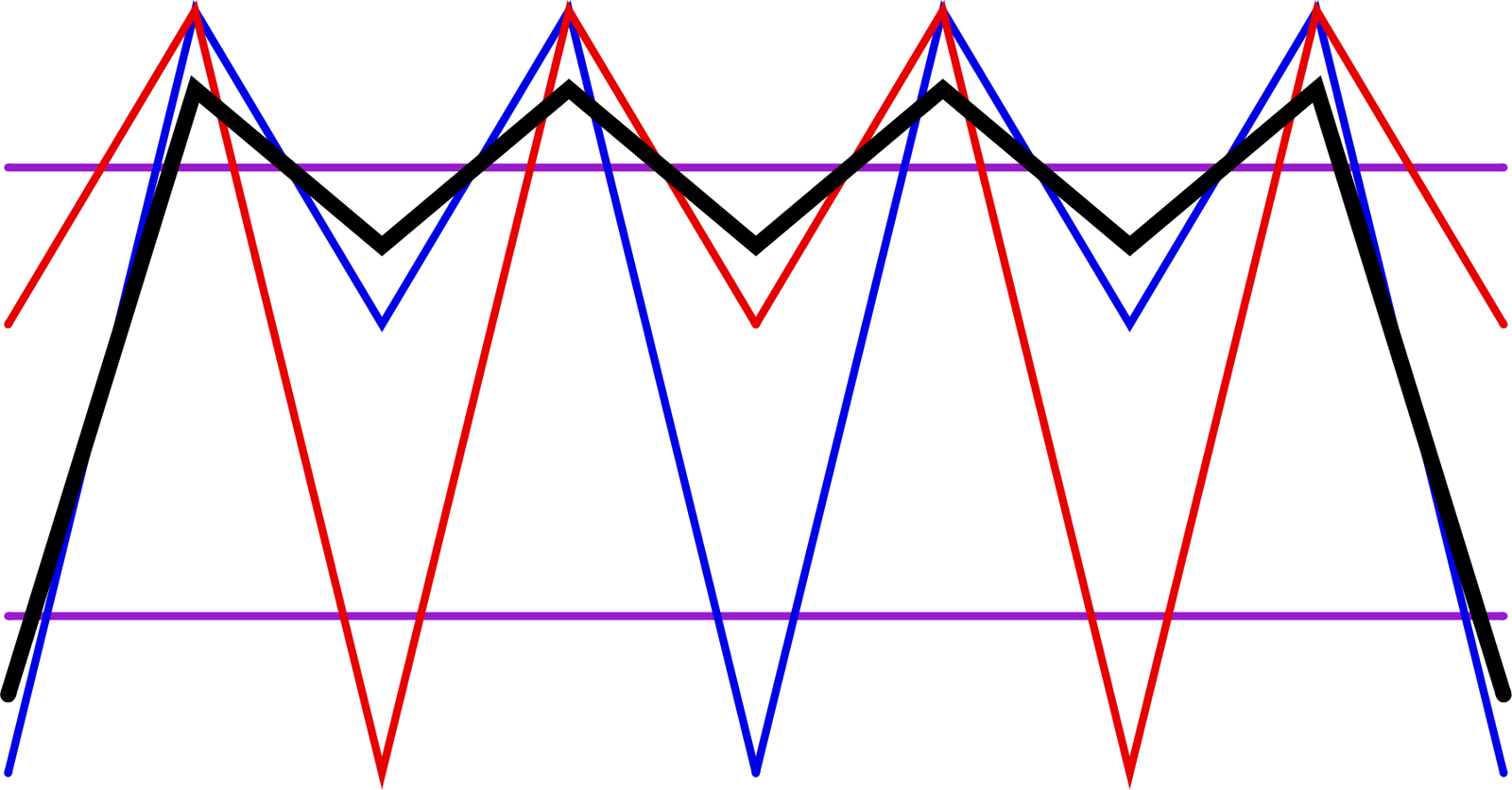
We prove in [3] that the stationary Swift–Hohenberg equation has chaotic dynamics on a critical energy level for a large continuous range of parameters. A computer-assisted continuation proves the existence of a periodic orbit with certain geometric properties; this orbit is then used as a skeleton through which other solutions are braided, forcing infinitely many braided periodic orbits. A semi-conjugacy to a subshift of finite type shows the dynamics is chaotic.
Related publications
- [78]From heteroclinic loops to homoclinic snaking in reversible systems: rigorous forcing through computer-assisted proofsJ.B. van den Berg, G. Duchesne and J.-P. LessardSIAM Journal on Applied Dynamical Systems, 25(3): 2355–2400, 2026
- [68]Towards computational Morse-Floer homology: forcing results for connecting orbits by computing relative indices of critical pointsFoundations of Computational Mathematics, 24(5): 1739–1776, 2024
- [3]Chaotic braided solutions via rigorous numerics: chaos in the Swift-Hohenberg equationJ.B. van den Berg and J.-P. LessardSIAM Journal on Applied Dynamical Systems, 7(3): 988–1031, 2008