Research / Rigorous continuation
Rigorous Continuation in Infinite Dimensions
As most physical and biological models depend on parameters, it is important to understand how solutions change as parameters vary. Applying finite dimensional continuation techniques to PDEs and DDEs requires a finite dimensional projection, which raises the fundamental question of the validity of the outputs. To address this, I develop rigorous continuation methods in infinite dimensions.
Multi-parameter continuation
When a problem depends on several parameters, its solutions form higher-dimensional manifolds rather than curves. In [26], we introduce a rigorous method to compute smooth manifolds implicitly defined by infinite-dimensional nonlinear operators. A simplicial triangulation of the manifold, obtained by multi-parameter continuation of a finite-dimensional projection, is turned into a validated atlas of smooth charts, and smoothness is proved across adjacent simplices. As an application, we compute portions of a two-dimensional manifold of equilibria of the Cahn–Hilliard equation. Two-parameter continuation is also the starting point of our method to detect and prove cusp bifurcations [73].
Global smooth branches of solutions
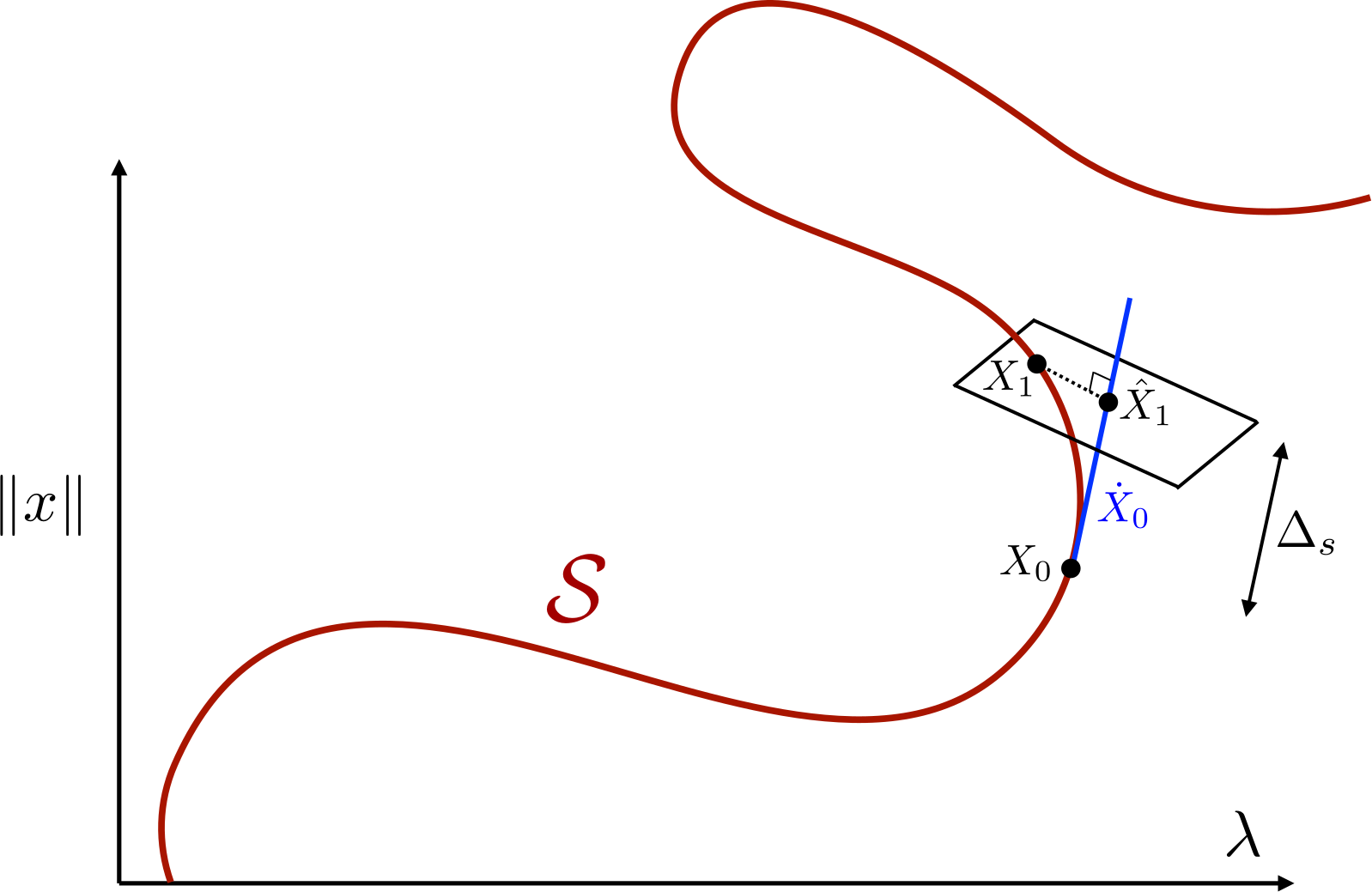
Most models depend on parameters, and continuation methods follow how their solutions change as the parameters vary. In [5], we introduce a method to rigorously compute smooth branches of zeros of nonlinear operators on Banach spaces, first for parameter continuation and then for pseudo-arclength continuation, which can follow branches around folds. Examples are given for ordinary, partial and delay differential equations. In [41], written for the AMS Short Course on rigorous numerics in dynamics, we give an introduction to these ideas and to their use in the study of delay differential equations.
A global bifurcation diagram for cross-diffusion
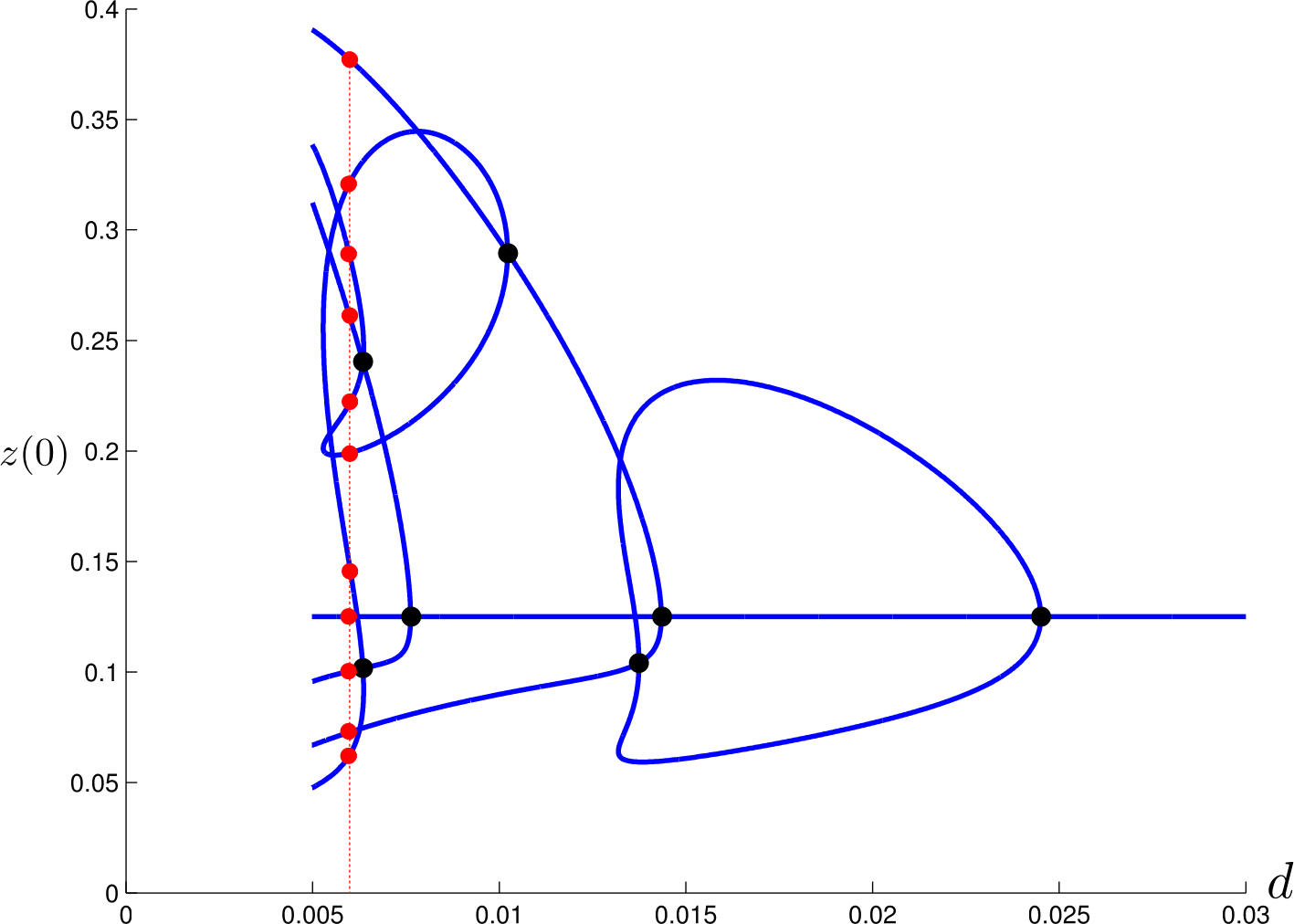
Cross-diffusion describes how the spatial movement of one species depends on the presence of others. In [14], we rigorously compute several global smooth branches of steady states for a system of three reaction-diffusion PDEs introduced by Iida et al. [J. Math. Biol. 53 (2006)] to study cross-diffusion between competing species. This gives an explicit and mathematically rigorous construction of a global bifurcation diagram, except in small neighborhoods of the bifurcation points. The method introduces new analytic estimates and a gluing-free construction of global branches.
Related publications
- [73]Cusp bifurcations: numerical detection via two-parameter continuation and computer-assisted proofs of existenceJ.-P. Lessard and A. PuglieseDiscrete and Continuous Dynamical Systems - Series B, 30(6): 2135–2158, 2025
- [41]Continuation of solutions and studying delay differential equations via rigorous numericsJ.-P. LessardRigorous numerics in dynamics, 81–122, Proc. Sympos. Appl. Math., 74, Amer. Math. Soc., Providence, RI, 2018
- [26]Computation of smooth manifolds via rigorous multi-parameter continuation in infinite dimensionsM. Gameiro, J.-P. Lessard and A. Pugliese.Foundations of Computational Mathematics, 16(2): 531–575, 2016
- [14]Global bifurcation diagram of steady states of systems of PDEs via rigorous numerics: a 3-component reaction-diffusion systemM. Breden, J.-P. Lessard and M. VanicatActa Mathematicae Applicandae, 128(1): 113–152, 2013
- [5]Global smooth solution curves using rigorous branch followingJ.B. van den Berg, J.-P. Lessard and K. MischaikowMathematics of Computation, 79 (271), 1565–1584, 2010