Research / The N-body problem
Celestial Mechanics and the N-Body Problem
Computer-assisted proofs are well suited to study the rich families of periodic motions in Hamiltonian systems from celestial mechanics, where symmetries can be exploited to isolate solutions.
Platonic constellations
Highly symmetric configurations of many bodies give rise to remarkable periodic motions. In [82], we consider a heavy central mass surrounded by n equal masses arranged according to the symmetry group of a Platonic solid, with 12, 24 or 60 small bodies. Starting from Kepler ellipses, we reduce the search for periodic orbits to finding nondegenerate critical points of an explicit function of the eccentricity and orientation of the orbit, which we verify with a computer-assisted proof. This yields families of periodic solutions of the 13-, 25- and 61-body problems with full tetrahedral, octahedral or icosahedral symmetry.
From the Lagrange triangle to the figure eight
For the three-body problem with equal masses, Marchal conjectured in 1999 that the family of periodic orbits born from Lagrange’s equilateral triangle solution contains the famous figure-eight choreography, discovered numerically by Moore and proven to exist by Chenciner and Montgomery. In [79], we prove Marchal’s conjecture. In [49], we gave numerical evidence that the same phenomenon occurs for the regular n-gon with an odd number of bodies up to 15, where the family leaves the plane and passes through spatial choreographies with the topology of torus knots before reaching the figure eight.
Vortices on the sphere
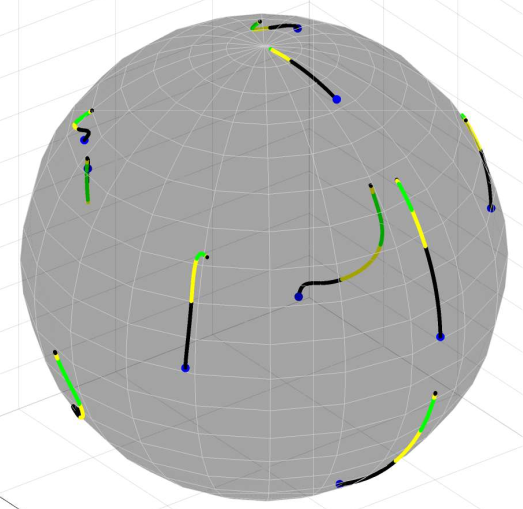
Point vortices moving on a sphere are a classical model in fluid dynamics. In [72], we study relative equilibria of the N-vortex problem formed by latitudinal rings of vortices of equal strength, rotating uniformly about the vertical axis, possibly with additional vortices at the poles. We develop a framework to prove the existence and orbital stability of branches of such relative equilibria, and implement it with computer-assisted proofs. This avoids the analytical difficulties that arise with two or more rings, and yields new rigorous results for configurations with 5 to 12 vortices.
Relative equilibria of charged particles
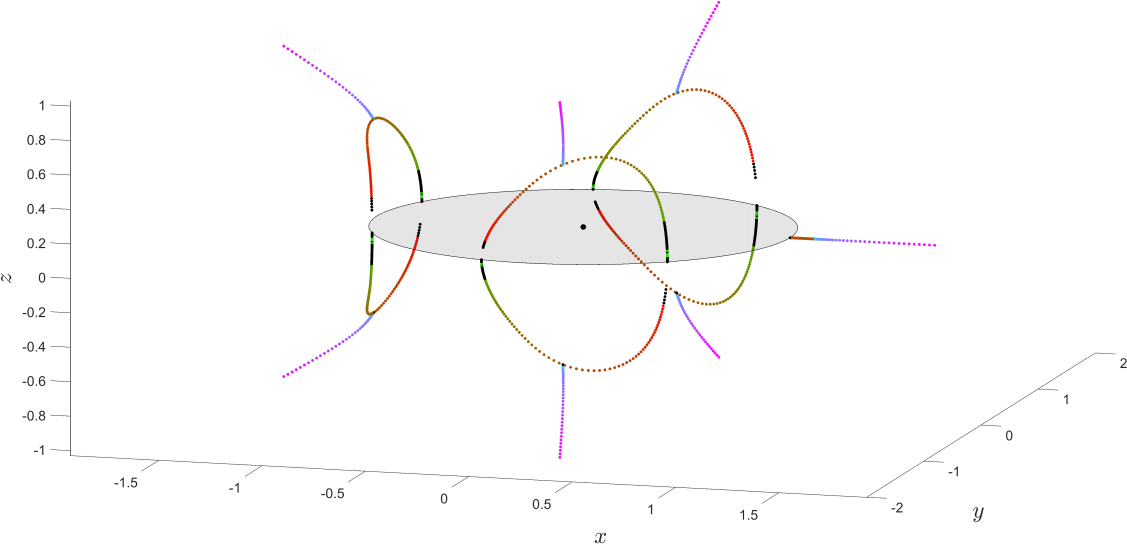
In a classical model of the atom, n electrons interact with each other and with a fixed nucleus. In [54], we show that two global branches of spatial relative equilibria bifurcate from the planar polygonal configuration at specific values of the nuclear charge; along them, the electrons form groups of regular polygons in space. Each of these relative equilibria also carries branches of relative periodic solutions. Using computer-assisted proofs, we establish several spatial relative equilibria far from the polygon, and verify the non-resonance condition needed for the periodic solutions.
Torus knot choreographies
A choreography is a periodic motion in which all bodies follow the same closed curve. In [48], we develop a systematic approach to prove the existence of spatial choreographies of the gravitational n-body problem whose common path winds around a torus, forming a torus knot. Using rotating coordinates and symmetries, the problem reduces to a delay differential equation for a single body, whose periodic solutions we study with computer-assisted proofs. We provide a working implementation for any number of bodies, and prove the existence of spatial choreographies for 4, 5, 7 and 9 bodies.
Halo orbits in the restricted four-body problem
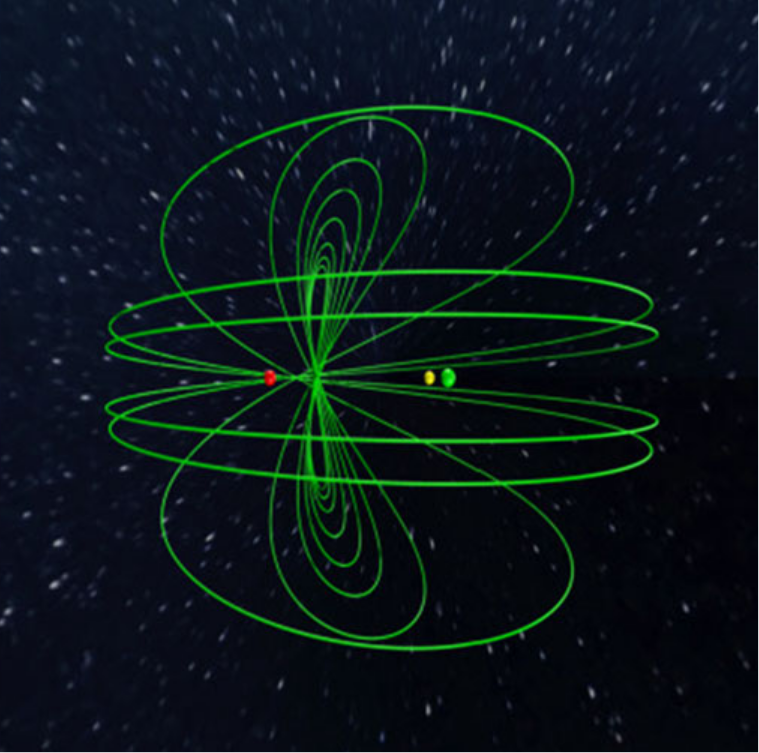
In the equilateral restricted four-body problem, a small body moves under the attraction of three massive bodies placed at the vertices of a rigidly rotating equilateral triangle. In [43], we prove the existence of spatial periodic orbits of this model, including vertical Lyapunov families in the triple Copenhagen problem, where the three masses are equal, as well as halo and axial families bifurcating from planar Lyapunov families. The proofs are constructive and non-perturbative, based on piecewise Chebyshev expansions, and cover both equal and unequal masses.
Related publications
- [82]Platonic constellations of periodic motions in the (n+1)- body problem PreprintK. Constantineau, C. García-Azpeitia and J.-P. LessardPreprint, 2026
- [79]From the Lagrange Triangle to the Figure Eight Choreography: Proof of Marchal’s Conjecture To appearTo appear in the Transactions of the American Mathematical Society, 2026
- [72]Determination of stable branches of relative equilibria of the N-vortex problem on the sphereCommunications in Mathematical Physics, 406(2), 47 pages, 2025
- [54]Spatial relative equilibria and periodic orbit of the Coulomb (n+1) body problemK. Constantineau, C. García-Azpeitia and J.-P. LessardQualitative Theory of Dynamical Systems, 21(3): 1–19, 2022
- [49]From the Lagrange polygon to the figure eight I: Numerical evidence extending a conjecture of MarchalCelestial Mechanics and Dynamical Astronomy, 133 (10): 1–20, 2021
- [48]Torus knot choreographies in the n-body problemNonlinearity, 34 (1): 313–349, 2021
- [43]Spatial periodic orbits in the equilateral circular restricted four body problem: computer assisted proofs of existenceJ. Burgos-Garcia, J.-P. Lessard and J.D. Mireles JamesCelestial Mechanics and Dynamical Astronomy, 131(1): 1–36, 2019